



















LIV Golf has filed for Chapter 11 bankruptcywhich means many of his business operations – past and future – have been forced into the public eye before his various court hearings. In total, LIV’s representation filed hundreds of pages of documents Tuesday night and Wednesday ahead of a hearing Wednesday afternoon before Judge Michael B. Kaplan in New Jersey.
We scrutinized these documents and selected several findings that help tell the story of where LIV has been and where it hopes to go. Check them out below.
1. The ticking clock reads: 34 days
In order for LIV Golf to return in a different form, it secured an agreement with the credit division of BC Partners to finance its interim bankruptcy monitored by the court, as well as exit financing to support the league going forward … as long as the players commit in early October.
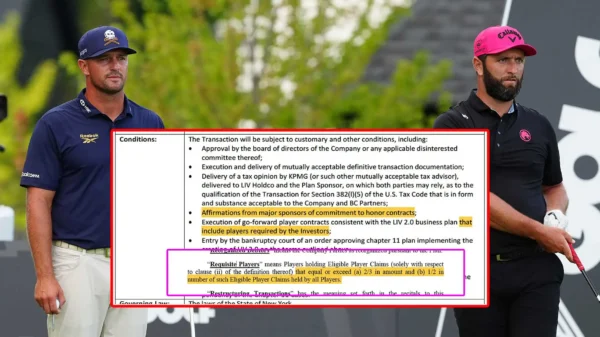
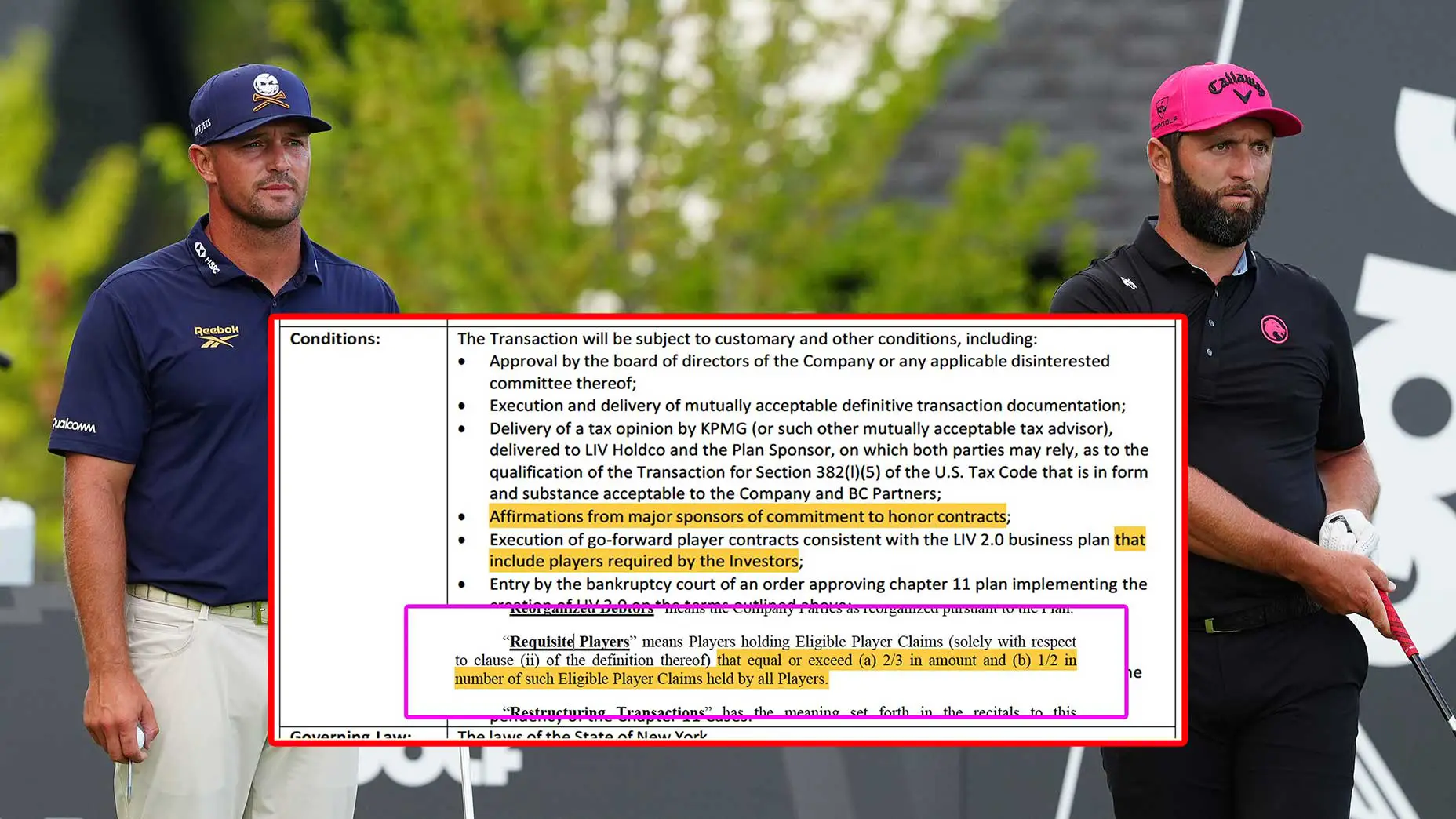
The documents include a term sheet between LIV and BC Partners, which says the transaction requires specific actors and number of players to join the deal within 35 days of the filing (which happened on Tuesday, September 8). Thirty-five days from September 8 is October 13.
According to the term sheet, 50% of the players with “claims” are needed for the deal to go through, and the collective value of the claims associated with the starting players must equal or exceed two-thirds of the total claims of the players. In other words, LIV needs sign-on from some of its bigger fish.
2. The investment is significant (but pending)
If LIV 2.0 comes to fruition, it will happen because of $300 million in total funding, much of which will come from BC Partners, and possibly from minority investors. As evidenced above, the term sheet is considered a “Restructuring Support Agreement” with various clauses that must be completed, and completed by a certain deadline.
While a lot needed to be done in the last month since BC Partners was first reported as “the main investor” of LIV, everything followed a flurry of pitches that Ducera Partners – an investment bank working on behalf of the PIF – made to potential financiers.
About 100 of those potential investors signed NDAs, and about 30 “engaged in detailed due diligence,” the documents said. Of those 30, two bids submitted by LIV’s July 22 deadline, after BC Partners was declared the lead bidder. In all, it is about 80 days from May 3, when the search officially began, to the deadline of the offer. It’s a narrow window, while LIV itself has visited four different countries for events.
And what did LIV bonus BC Partners, at least hypothetically? The right to own a LIV expansion team in the future, at almost no initial cost.
;)
3. April 13 was actually D-Day
Flash back to the 2026 Masters, where Rory McIlroy will defend his title on Sunday, April 11. Just a few days later, on Wednesday evening, April 14, Ryan French of Monday Q Info posted about an upcoming “bombshell announcement”, and alluded to a liquidation of events.
6. LIV is down to $15 million in cash
When the Saudis decided to stop funding LIV, the end of the road began to take shape. Without a theoretical blank check and annual payments of hundreds of millions of dollars from the Middle East, LIV was forced to operate differently immediately. This is how (very quietly) a golf league widely known as a sporting event adjacent to a music festival has just hosted. one concert from May to August. It happened in Korea, and was the surest sign that despite not recognizing this trend, LIV’s late cancellation of their Indiana concerts was a virtual certainty weeks if not months earlier.
According to the filing, as of this week, LIV only had $15 million in spending cash remaining, further evidence of how it was unable to pay vendors for services rendered through 2026. Despite that shortfall, the filing included this fascinating line from David Orlofsky, head of restructuring:
“LIV Golf firmly believes that, with adequate financing and a level playing field with its competitors, its existing operating model would have reached profitability in five to seven years, mainly due to continued growth of revenues in the League and in the teams, which will increase significantly in 2025 and 2026.”
This aligns, at least loosely, with Scott O’Neil’s now infamous quote toThe Financial Times in February, that LIV does not break even for five to 10 years.
7. Curious, single-player clauses
Among the many clauses and statements in the file are several items that show individual players have done personal business with the league. First among them was a small slice of league equity (0.23%) granted to a current player, with the same amount for Greg Norman. The identity of the player is not clear, but it can be assumed that he would be among the biggest signings of the league.
;)
A different clause buried in the filing suggests that a player has reached an “indemnification agreement” with LIV that will see the league provide up to $3 million in joint legal support related to a specific claim from that player’s pre-existing sponsor agreement. In simpler terms, an LIV player reached an agreement to have the league returned to him if a disgruntled sponsor took legal action against him.
At last, Financial Times reporter Sujeet Indap found a clause that clarified how a player’s CIGNA health insurance plan was covered in full by the league.
8. Player NIL, property a significant factor that advances
How does LIV 2.0 hope to make the players whole for the unpaid debts owed to them? This is clear from the BC Partners agreement, which clarifies that the players will own a majority of 52.5% of the league – a fact that the new representatives of LIV wanted to declare in court on Wednesday.
It states that “in exchange for agreeing to play in LIV 2.0” players will receive a modified contract with signing bonuses, joint ownership of around 30% in the teams they play for and, most importantly for some, a “return of certain NIL rights”. What rights, exactly, have not yet been clarified, but for a widely marketed actor like Bryson DeChambeau, this element could be particularly seductive.
9. Request to reject player contracts
As part of its filing, LIV asked the bankruptcy court to allow it to reject various contracts and leases in which the league had entered. That includes things like the lease he had made for offices in West Palm Beach, Fla., and Scottsdale, Ariz.; arrangements for specific team trainers; but also player contracts.
Some of these “contracts” were “player participation agreements” – also contracts that formally lock players into specific LIV events / seasons – as well as dated “letter agreements” that suggest the initial times on which various LIV commitments were taken seriously by the league.
For example, Henrik Stenson, Lee Westwood and Ian Poulter are all listed as having established “Letter Agreements” on May 10, 2022. While Poulter and Westwood played in the first LIV event a month later, Stenson took an extra month and a half to commit to LIV, ultimately losing the European Ryder Cup captaincy process.
To show how direct these Letter Agreements could representing the player’s interest at a certain date, Joaquin Niemann’s Letter Agreement is listed as August 28, 2022, the same day. James Corrigan said in The Telegraph that Niemann had signed with the league. That same week, Niemann attended the Tiger Woods-led gathering of the Tour’s best players that gave birth to the Tour’s Signature Events model.
Interestingly, the name of PGA Tour star Cameron Young is also listed with a Letter of Agreement dated July 24, 2022, a week after his solo second place at the Open 2022. It serves as a reminder that during the summer of 2022, many players were approached by LIV, and Young took it very seriously before finally committing to the PGA Tour, which he has. accepted a month later at the 2022 Tour Championship.
;)