































































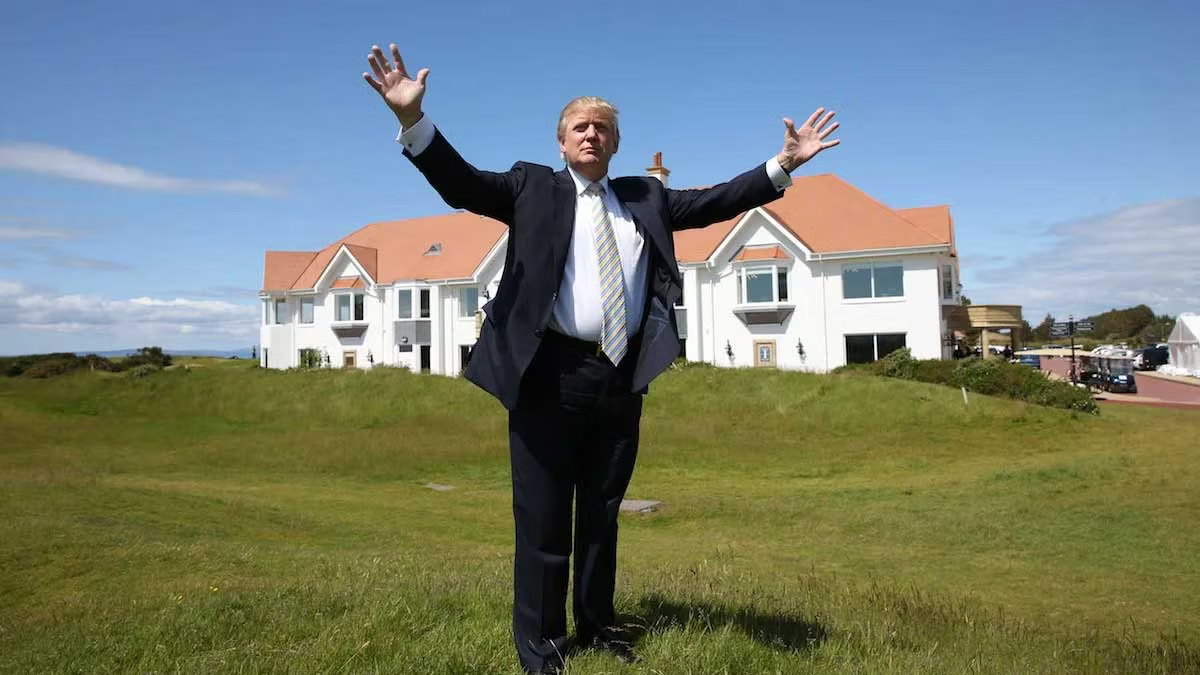
“I’ve had friends tell me I’m into gardening,” Donald Trump told me.
It was years before his first term as president. This was one of his regular topics in our long conversations/interviews. “I never had. It seemed so boring to me. But when I started building golf courses I did. Building a golf course is like gardening, but on a much larger scale.”
As a golf course owner, Trump often sparred with various architects and contractors — some members of the Fazio family; Jack Nicklaus; various others – insisting that he had superior ideas for the locations of cart paths, halfway houses, practice areas, elevated tees on artificial hills, dug-out green ponds and waterfalls. He loved the falls.
Trump was hot and cold on trees. He planted thousands of them when he built his first course, the very private Trump International Golf Club, on a flat, desolate former fairway near Palm Beach International Airport. But when he built the public Ferry Point course in the Bronx, on an old hard dump from the East River, he wanted a windy course with a Scottish look and no trees.
The Trump Administration’s East Potomac Course renovation proposal is closer to the Ferry Point project than anything else Trump has done as a private golf entrepreneur. President Trump spent hours speaking with legendary course architect Tom Fazio about what the historic public course, diminished but popular, could be like with a total makeover. Trump envisions it as a course suited for tournament play.
Championship golf on their courses is a concern for Trump. Once, in an interview, I suggested that he could be the first owner of the course to host Ryder Cups on both sides of the Atlantic. He ran with that theme, setting up his course in Manassas, Virginia, for a U.S. Ryder Cup, and his seaside course in Aberdeen, Scotland, for a European, although he named many other Trump-branded courses. He also talked about hosting US Opens and British Opens. He can talk about golf all day. The East Potomac course is on federal land, with a view of the Washington Monument. Can you imagine a Ryder Cup in such an environment? The president can.
Last weekend, and in open defiance of a federal court order that severely restricted what tree removal could be done for now at East Potomac, the National Park Service. cut down at least 400 trees (a conservative estimate) in a short, intense and hastily announced program. The president was not out with a chainsaw, but Jessica Bowron, the director of the National Park Service, reports to Doug Burgum, the secretary of the Department of the Interior, and Burgum reports to President Trump, and President Trump flies over the course of the East Potomac on a regular basis. He has a lingering interest in all of this. In the name of preserving democratic norms (lowercase d), you hope that this is not a case of what the president knew and when he knew.
All the while, golfers in East Potomac continued to play. It is the view of East Potomac, the accessibility, the casualness and the rate that makes the place so popular, plus a nice snack bar, although the service can be surly. The weekend green fee on its Blue course tops out at $48, and children and military members play for about half that. East Potomac is a prime example of public, urban golf without the fuss. Ferry Point, now called Bally’s Golf Links at Ferry Point and a New York City course, is not. The Trump Golf empire is all about golden golf. Trump told me – again, years ago – that one of the things he likes about investing in high-end courses is that if he’s interested in golf courses, he can always turn his properties into high-end housing developments. Presumably, this could never happen at East Potomac, being a federal park and all.
As Trump waded into presidential politics, he made a funny politics-meets-golf observation. He compared the electoral college to match play and the popular vote to stroke play.
Along similar lines, you can compare the US court system and the USGA’s role in American (and Mexican) golf tournaments. Let’s say a player in a US Open finds himself in an intra-hole rules dispute. When the player calls a rules official, it is like a plaintiff taking a dispute to court. Players who do not like their decisions in real time can appeal the decisions to the rules committee of the tournament at the end of the game, and this is the end of the line, the Supreme Court of golf. The USGA rules committee gave Dustin Johnson a one-stroke penalty after finishing the last round of the US Open 2016. There was really nothing Johnson could do except sign his scorecard. I wasn’t about to do that. He had won the tournament.
Not to bore you too much, here in your morning sports section, but Article III of the United States Constitution gives the federal courts the power to settle public and private disputes. That’s why the judge overseeing this land use dispute, Ana Reyes of the federal district court in Washington, DC, he was so enraged from the hasty, large-scale tree removal. He violated the judicial and constitutional authority that comes with his job. It doesn’t matter that many East Potomac golfers say the course has been taken down by its trees, many of which are scraggly.
Golf course renovation work on public lands is not a place for the impulsive. A group called the National Links Trust has spent nearly a decade coming up with plans, and raising money, to restore and improve public golf in the nation’s capital. The folks at NLT have been talking for years about getting the East Potomac course back to the inventive, reversible course that Walter Travis designed more than a century ago. Tom Fazio’s vision for the course is distinctly more modern and different.
Such debates are common throughout golf. The Augusta Municipal Golf Course, aka The Patch, a beloved but rundown public course a couple of miles from Augusta National, has undergone a major renovation in the last two years, supervised by Tom Fazio and another architect, Beau Welling. By many local accounts, it is a different course today, certainly a more conventional course, and better, at least to some reviewers. The word “best” in golf is always elusive. One golfer’s “best” is another’s “ruined”.
President Trump’s roots in public golf may be deeper than you think, given how wealthy his family was growing up in the Jamaica Estates section of Queens, New York City. He told me, on more than one occasion, that he took up golf in his years at the Wharton School of the University of Pennsylvania, which he attended from the fall of 1966 to the spring of 1968. He described driving his own car west from Penn’s West Philadelphia campus to the Cobbs Creek course, a celebrated home for black golfers in Philadelphia. Cobbs was a place with a lot of action and a city atmosphere. Trump once said Golf Digest that the course had “no grass on the tees, no nothing.” He remembered the racists here. “I mean, more hunters than any place I’ve seen so far.” He took what he learned there to Winged Foot, which he joined in 1969; at his West Palm course, which opened in 1999; at Turnberry, the famous Scottish course he bought in 2014. “I learned about golf (at Cobbs Creek),” Trump said. “I learned about the game. I learned about everything.”
Cobbs Creek has now arrived a great renovation of his own. It is no longer the epicenter for black golf in Philadelphia and has not been for years. Games with serious action have migrated elsewhere in the city, in its suburbs and on the Jersey Shore. There is a Tiger Woods Learning Center in Cobbs Creek now. Cobbs Creek, like the Augusta muni and the Park in West Palm Beach, is about the best golf. There is a cultural divide in East Potomac that is at the heart of the fight for its future. The plans of the National Links Trust are rooted in better golf, bringing children to the game, keeping the elderly, celebrating the traditional values of golf, keeping golf affordable. Trump Golf isn’t built for that, and neither is Trump. He likes golf courses that are show pieces. He likes it spiffy.
Monday, at 10 am at the US District Court in Washington, there will be a hearing on the status of the removal of trees in East Potomac. It could be interesting, if you are in the jurisprudence of golf and the wheels of justice and the rest. If not, we’ll point you to Golf Channel, scheduled to broadcast LPGA action from the Sheshan International Golf Club in Shanghai, China.
Michael Bamberger welcomes your comments at Michael.Bamberger@Golf.com.
“>