






































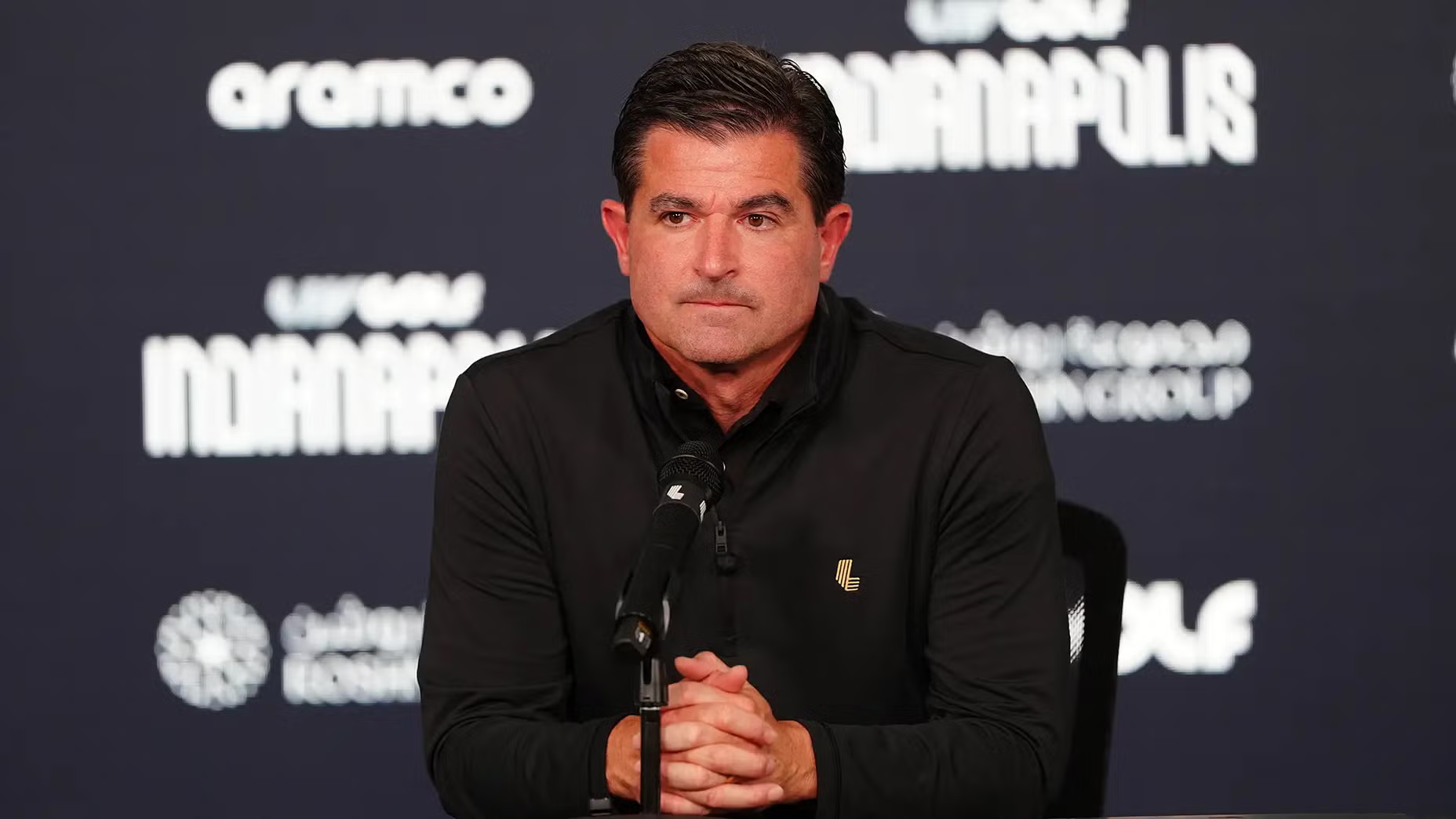
After months of rumors, lawsuits and financial woes, LIV Golf has officially filed for bankruptcy. The rival golf league that took on the status quo in pro golf filed for Chapter 11 bankruptcy in New Jersey, formally marking an end to, as Jon Rahm called Tuesday morning, LIV Golf 1.0. Chapter 11 is best understood as a corporate restructuring mechanism with the intention of continuing.
The filing arrived shortly after 4 pm ET and includes some previously unreleased information, such as money owed to players and various vendors who recently took LIV to court for unpaid services. Also on Tuesday, we had confirmation of LIV’s “lead investor” that CEO Scott O’Neil first mentioned a month ago; O’Neil also wrote a letter to fans The next phase of LIV.
Here’s what we know from the initial documents released Tuesday.
LIV GOLF BANKRUPTCY: HERE WE KNOW
— — — —
LIV owes several parties more than $1 million
Part of the bankruptcy filing requires a company to list the 30 people and/or entities that owe the most money. The initial filing suggests that LIV owes at least 24 different parties more than $1 million, ranging from Jon Rahm ($7.4 million) at the top to Lucas Herbert ($1.01 million) at the bottom.
Included among them is Brooks Koepka, who left LIV 10 months ago and is owed about $1.68 million. YouTuber Rick Shiels is also owed about $1.4 million, stemming from an official partnership he made with the league years ago. There are many others, such as the State of Louisiana, or even the Asian Tour, which serves as a reminder of the wide web of partnerships LIV Golf tried to maintain before the Saudi PIF decided to end its financing of the company.
But this still required PIF funding
As part of the filing, the Saudi PIF will lend $49.6 million to LIV Golf as part of the Debtor-in-Possession financing, likely the final touches to Saudi financing that has reached nearly $6 billion over the past five years.
It was only 4 1/2 months ago that the PIF said that only finance LIV through the 2026 season, and even that was a short-lived promise. LIV quickly postponed and canceled their New Orleans event and eventually canceled their Tag Team Championship in Michigan, folding part of it in the process of their final individual event in Indianapolis.
Players’ contract figures vary widely
A quick read of the players on the list of the biggest creditors shows no surprise at the top of Rahm. Bryson DeChambeau follows at $5.7 million and Dustin Johnson at $5.4 million. These claims are associated with the “Player Participation Agreement” – aka game contracts, which LIV famously brought to golf pro.
New Jersey Bankruptcy Court
But keen observers will note how those amounts pale in comparison to the hundreds of millions reported in the initial contracts the players signed when they joined LIV. All that is to say: it is difficult to know what these amounts really represent. Can there be only one installment remaining on the contracts? Could they only be around for the rest of 2026? Could they be what’s left after LIV allows players to keep their full NIL value in a future iteration of the league? So far it is not clear.
Litigation LIV is shown
The last few weeks have seen many companies proceed with the suit against LIV Golf for unpaid services and breaches of contract, which lists them as official creditors on the file. A company like Fresh Tape Media, which is suing LIV for more than $1.2 million, is on the list of creditors. Also listed, in a similar but different sense, is World Golf Group Limited and Premier Golf League – the entity that originally sought to launch a rival golf league. The amount owed to WGG and PGL is listed as “undetermined”, which is due to ongoing litigation in the UK.
Having these entities listed does not necessarily mean that monetary differences will be resolved. For the moment, the bankruptcy filing automatically stops the ongoing litigation in almost all cases, putting a stay on the growing lawsuits that LIV was facing.
“Principal Investor” named
It was just five weeks ago, on August 5, that O’Neil first said that his league had signed a term with a “lead investor” for the second iteration of the league. It was quickly reported that the investor was the credit wing firm BC Partners, led in this effort by Ted Goldthorpe. A week later, Goldthorpe was in Indiana, making a pitch to the players in his final event. While O’Neil and the league refused to recognize BC Partners in any official capacity during the last month, today he finally had.
In conjunction with the news, LIV issued a press release naming BCP as that investor, listing it as a future sponsor that would provide exit financing at the other end of what it believes will be its path to bankruptcy. He also said minority partners could join that future sponsorship/exit funding.
The future of LIV?
All this, of course, is subject to the approval of the court. New Jersey bankruptcy judge Michael B. Kaplan was assigned the case Tuesday, while voluntary petitions were filed for each of the dozens of LIV branches it used to operate its business.
But “LIV 2.0”, as has been discussed many times, is all about a player’s league, which O’Neil said in a letter to fans. In that letter is an update of what LIV 2.0 looks like, of which one line in particular was:
“We intend to expand our fields to 75 players, introduce a cut, and create additional pathways for players to earn their way into LIV Golf, including Monday’s qualifiers.”
That would certainly look like a very different golf league. To make good on this week’s promise, O’Neil now has about five months to make it happen. LIV’s press release suggested it hopes to emerge from Chapter 11 in early 2027.