




















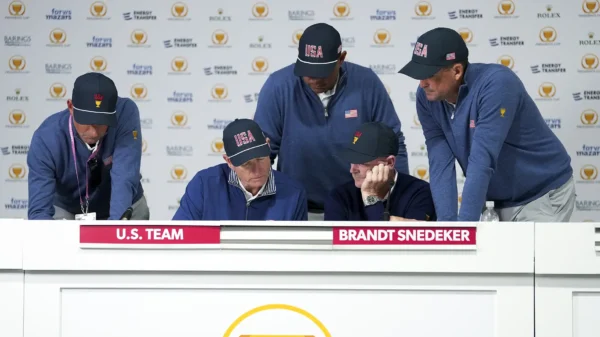











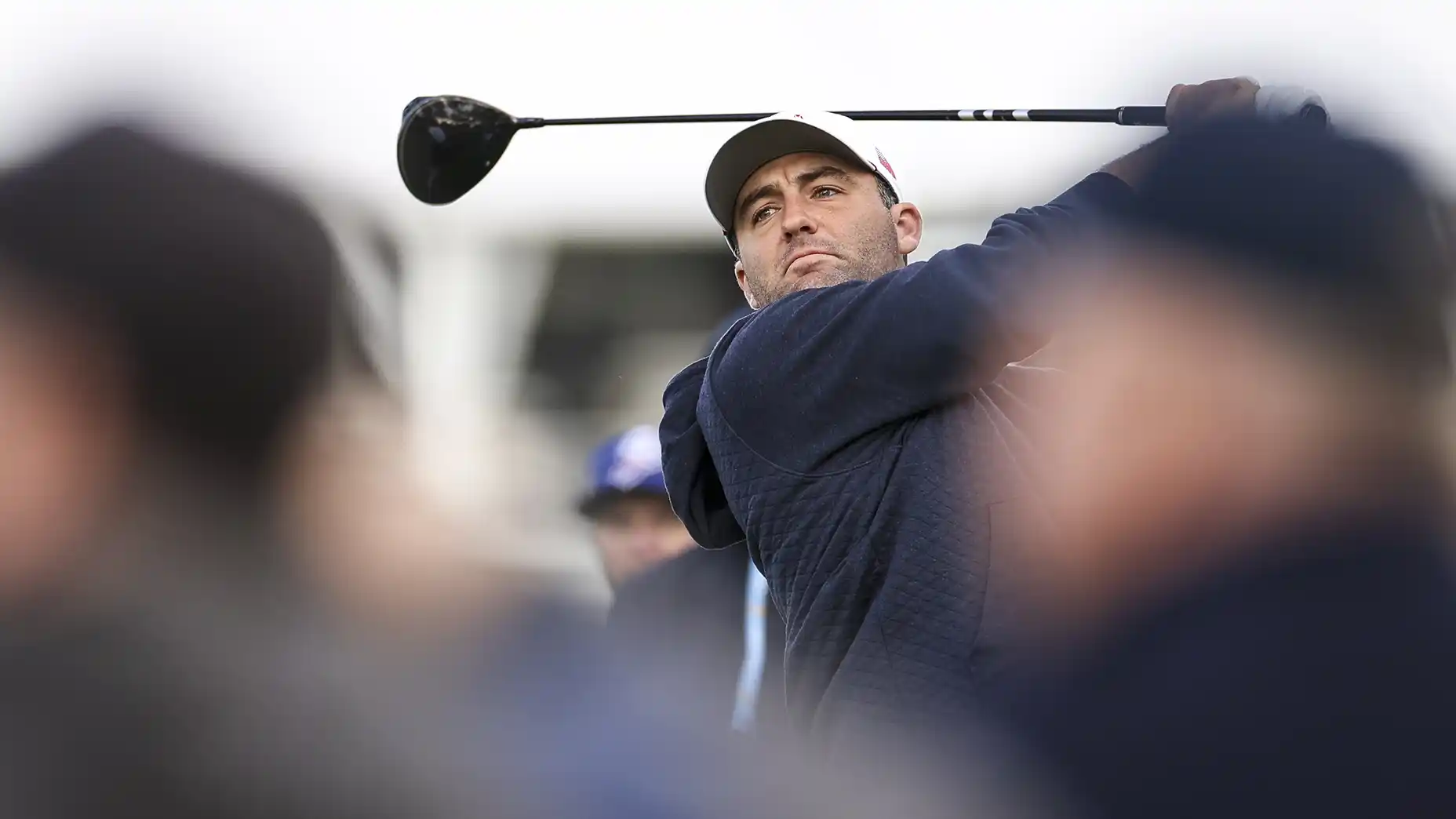
MEDINAH, Ill. – Brandt Snedeker? He says it was a “great” question.
Geoff Ogilvy? He found it “interesting”.
Russell Henley, when asked, said he couldn’t put his finger on an answer. Sam Burns said he didn’t have a perfect one. Scottie Scheffler said anyone could come up with 100 reasons.
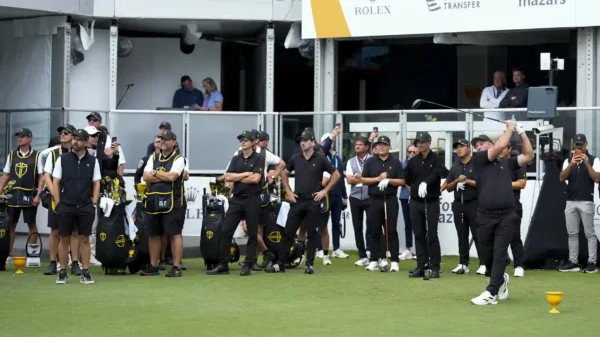
In conclusion, the consensus was confused on Tuesday at Medinah Country Clubwhen the sides of this week Presidents’ Cup they were asked a question that was more profound than the pizzas in nearby Chicago.
Why have the Americans done so well in the Presidents Cup – and not so well recently in the Ryder Cup?
The format, after all, is basically the same — 12 American pros versus a dozen European or international pros in match play — and yet, in the last seven games, the Europeans hold a 5-2 advantage, while the Internationals are 0-7 (and 1-13-1 all-time). Are those players, then? Or perhaps, as Scheffler suggests, there is more to see.
So let’s do that.
OK, are they the players?
Of course it is. Right? Players hit shots. Period.
That suggests a talent gap, and for our purposes here, we look at the world rankings, although they have their critics and only last year folded in some LIV Golf results. Below is a look at the last three Ryder and Presidents Cups:
Ryder Cup 2021: USA wins 19-9; The average world ranking of the United States is 8.9; Europe is 30.8
2023 Ryder Cup: Europe wins 16.5-11.5; The average world ranking of the United States is 12.9; Europe is 30
2025 Ryder Cup: Europe wins 15-13; The average world ranking of the United States is 11.1; Europe is 23.6
Presidents’ Cup 2022: USA wins 17.5-12.2; The average world ranking of the United States is 11.6; International is 48.9
Presidents’ Cup 2024: USA wins 18.5-11.5; The average world ranking of the United States is 11.9; International is 34.25
Presidents’ Cup 2026: The average world ranking of the United States is 15.1; Internationally it is 50.8
In the last three Ryder and Presidents Cups, the ranking shows that the Europeans (28.1 average ranking) were ranked better than the Internationals (44.65) – but the Americans (11.9) were ranked better than both sides in each event. What is also notable is that the Internationals had only one player ranked in the top 10 (Hideki Matsuyama in 2024), while the Europeans had eight.
But do the ranking gaps between Americans and Europeans (16.2) and Americans and Internationals (32.75) mean anything? what you do much more successful? It is possible. Let’s continue.
Is it the experience?
Since playing in team events and match play is rare in pro golf, the experience can be beneficial. Knowing the dynamics and having continuity can help – although the fresh aspect was also welcomed. The US also plays one team event each year, while the Europeans and Internationals play every other.
Below is a look at the number of previous Cups played for the last three Ryder and Presidents Cups:
Ryder Cup 2021: The average previous US appearance is 1; Europe is 3.2
2023 Ryder Cup: The average US aspect ratio is 1.4; Europe is 1.75
2025 Ryder Cup: The average US aspect ratio is 1.25; Europe is 2.7
Presidents’ Cup 2022: The US average aspect ratio is .75; International is 1.25
Presidents’ Cup 2024: The US average aspect ratio is 0.9; International is 2.3
Presidents’ Cup 2026: The US average aspect ratio is 1.5; International is 2.5
The Europeans and Internationals have had more experience, although the Internationals’ numbers are boosted by Adam Scott (12th appearance this year) and Hideki Matsuyama (seventh appearance this year).
Is LIV Golf?
Since LIV Golf began play in 2022, its players have played in Ryder Cups — but not Presidents Cups. At the Ryder Cup, the governing bodies of the teams (PGA of America for the United States and DP World Tour for the Europeans) allow LIV players, but the Presidents Cup is managed entirely by the PGA Tour, which blocks LIV from the event.
What did it mean? The international side was without Cameron Smith, Joaquin Niemann, Lucas Herbert, Louis Oosthuizen and Dean Burmester, although the Americans were unable to play Bryson DeChambeau, among others. Interestingly, Golf Digest said that Geoff Ogilvy, when he accepted the offer to become international captain, asked if he could pick the LIV players.
Are the golf courses?
Of course, this plays a factor; it’s what the players play. Teams added courses either to strengthen their own side or weaken the opponent. In the last two Ryder Cups hosted, for example, the Europeans have pinched the fairways and grown rough – although the Americans were beaten last year at the Ryder Cup when they cut the rough at Bethpage Black, only to see that the rain softens the course.
This week in Medina, there is also rain.
“As a home captain, that’s one of the advantages,” said Snedeker, the U.S. captain this week. “You can set parameters with how the golf course should be set up. It was very clear with our Tour staff how we want this place to try to get there, (but) kind of strangely similar to what happened at Bethpage, (that) it didn’t go according to plan. So you can have a great plan in front of you, but mother nature puts a wrench in it, and we have to deal with other factors.
“I talked to the guys a ton about it. It’s like, I don’t care where we play. You guys shouldn’t care where we play. We’re going to play another team. Be competitors. Go out there and be competitors. And they are. These guys are the best competitors in the world.
“You try to do everything you can to stack the odds in your favor, but at the end of the day, guys have to go out there and do it.”
Were the captains?
It depends on who you ask. For the last two Ryder Cups, the Europeans have sworn by captain Luke Donald, whose attention to detail is remarkable – in last year’s Ryder Cup, for example, he worked to find the right shampoo for his team. There is also the management of the schedule of the week – at the Ryder Cup 2021, the American captain Steve Stricker saw that the Americans had a good amount of freedom. There is also a lineup-setting, and the captains have always been guessed here – for the last two Ryder Cups, Donald’s choices have, for the most part, avoided criticism, while the Americans have been hammered.
So there is what Jack Nicklaus once did he told Golf Digest: :
“Just show up, keep it and shut up. You have to know when to be there, know what’s going on, and keep your mouth shut until it’s time to speak. Being a captain is a little easy.”
Was it analytics?
Europe, behind Edoardo Molnari, has set the standard here. The United States, meanwhile, will return to the team of Justin Ray and Hunter Stewart next year. Stewart is also at the Presidents Cup.
The question is, how much does a team rely on data?
“I think the best way to summarize the stats is that the stats are fantastic in 10,000-round models,” Snedeker said. “We played an 18-hole match. Use them to help you make informed decisions, but you can’t just stick to them. You have to see what your eyes see.
“Most of these matches will end in 12, 13, 14 holes for the most part. The stats don’t necessarily support this over three days of golf, four days of golf.
“You can use it to help you make decisions, to help you understand what strengths and weaknesses you have and that kind of thing, matchups potentially, but you have to trust your eyes, you have to trust your gut. You need to use it in the right way.”
Was it the selection system?
Interestingly, the US has revamped its system going into next year’s Ryder Cup. Now, only playing in 2027 will be used as part of their points classification; before the Americans also used last year’s events.
European and US Presidents’ Cup teams use events from current and previous years. The Internationals use the world ranking.
Was it the “vibe?”
This is difficult to quantify. Are Americans united? Are the Euros more united? At recent events, for example, a lot of attention was also given to whether the players of the United States will be paid.
Perhaps it’s telling that Ryan Fox of the International team recently said that the Internationals wanted to be a little more like Team Europe.
“I think we can definitely emulate them and take some of that — how they come together as a team,” he said. “I think it’s – the European Team has done a great job in this probably the last decade, maybe even longer, just having as a collective goal, I feel like we’re close to it as an International Team. It certainly feels like that this year.
“I think that’s the way we win is to have that collective goal, everybody buys in, and yeah, it’s going to be an exciting week for us next week.”
Was it just, well, golf?
You know, there’s this. Players can be hot at the right moments, and cold at the wrong ones.
It’s just golf.
So what is the answer? Maybe it’s the players. But perhaps Scheffler was also right:
A hundred (or more) reasons add up.
“I think every team is different,” Snedeker said. “I think trying to discover the secret sauce, if you want, because the success has been this way is the hardest question that we have to try to answer. Each team is different. The composition of each team is different. The link in each team is different. So I try to navigate that is really, really difficult.”
“>