

















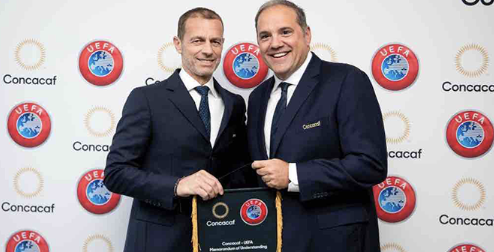




























September 18: FIFA vice-presidents Aleksander Ceferin and Victor Montagliani have asked their confederation presidential colleagues to back their proposal to use FIFA’s reserves to distribute an extra $10 million to each member association over the 2031-2034 cycle.
In a letter titled ‘Request for review of FIFA reserves’, they say: “The purpose of this communication is to give the FIFA Council the opportunity to review the FIFA 2026 year-end cash reserves and determine an amount that each member association could receive as a benefit of the recent success of the 2026 FIFA World Cup. This amount would be a one-off release of reserves, over and above the full program approved by FIFA.
“We would appreciate it if each of you, in your capacity as FIFA Council Members and Confederation Presidents, would support this motion.”
The request is a direct challenge to some of Infantino’s biggest supporters, particularly those in Africa and South America, some of whom have said they will continue to support Infantino. This support is based on Infantino’s pledge of money.
Simply put, what Ceferin and Montagliani are telling them is that the money is in FIFA’s reserves and can be distributed without Infantino’s conditions.
The message is that federations that want more money can have it, and without having to slavishly tow the line of Infantino’s political demand. And if the money is there, why has Infantino held it back and why has he pushed for a private equity sale? What is your reason? Although the last question doesn’t take much imagination to come up with sets of scenarios.
Attack on Infantino’s base support
The fan base of Infantino’s federation is based on the illusion that the FIFA grant money is a gift from the FIFA president and not as a statutory and constitutional right as part of their FIFA membership.
While presidents of member associations across the confederations are generally uncomfortable with Infantino’s leadership, they are more concerned with making sure they get promised development money without consequential demands. If demands are made, they are invariably forced to meet them to ensure they get their money.
Ceferin and Montaglini point out that the money is unconditional and should never come with Infantino.
Some of the confederation’s presidents, Patrice Motsepe of CAF and Alejandro Domínguez of Conmebol in particular, would find it difficult to go against the economic opportunity of their own member associations by continuing to support Infantino.
The letter said: “The confederations jointly complete this analysis (of FIFA’s reserves) and agree on the amount of FIFA’s reserves that should be delivered directly to the municipal authorities, with recommendations on disbursements presented for consideration through FIFA’s appropriate governance process at the next FIFA Council meeting.”
Contact the writer of this story at (email protected)