









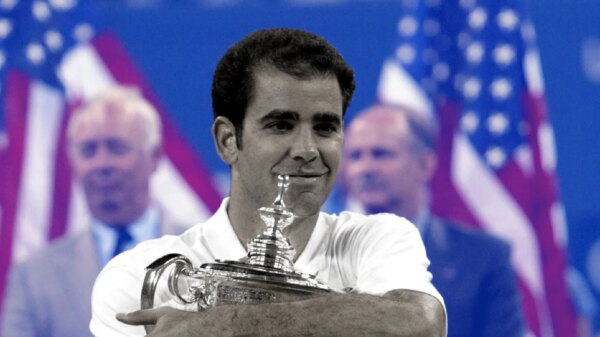









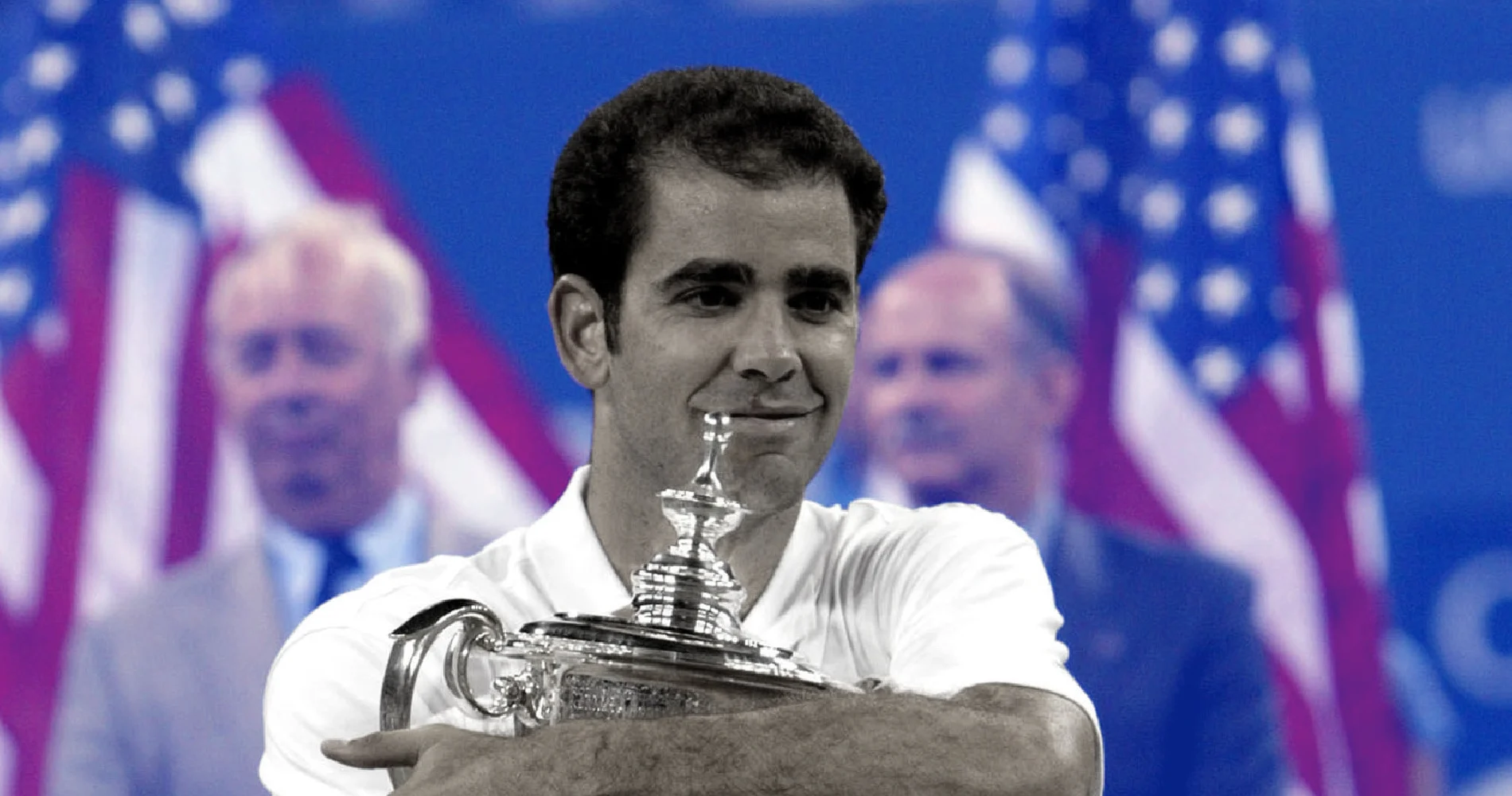
This was Sampras’ 14th A Grand Slam title that was a record at the time. Although he would not officially announce his retirement until the 2003 US Open, the 2002 final would remain the final match of his amazing career.
The playersPete Sampras and Andre Agassi
- Pete Sampras, former World No. 1, senior champion
Born in 1971, Pete Sampras dominated the game in the 1990s. After his first Grand Slam at the 1990 US Open (where he became the youngest men’s champion of all time, beating Agassi 6-4, 6-3, 6-2 in the final), he became world No. 1 in April 1993. After being criticized for reaching the top spot for more than two years without a major title, he won the Ensemble title three times in a row; 1993, followed by the Australian Open in 1994.
He finished the next six seasons (1993-1998) as world No. 1, setting a record that will remain unbroken. His service-volley game was particularly lethal on the grass at the All England Club, where he won seven titles between 1993 and 2000, only to lose in the quarter-finals in 1996 to Richard Krajicek. Pete Sampras also won the US Open four times (1990, 1993, 1995, 1996) and the Australian Open twice (1994, 1997), setting a then-record 13 Grand Slam titles.
In addition, the American won the Masters Cup five times (1991, 1994, 1996, 1997, 1999), accumulating a total of 63 titles in his career. At the time he also held the record for longest tenure as world No. 1 (286 weeks), Pete Sampras would easily be named the greatest of all time if it weren’t for his apparent weakness on clay;
Among the many unforgettable moments of his great careerTennis fans will always remember his tears during the 1995 Australian Open quarter-final against Jim Courier, when Sampras was shocked after learning that his coach Tim Gullickson had been diagnosed with a brain tumour.
From a technical point of view, Pete Sampras was known for his deadly serve, his amazing running forehand, his spectacular slam dunk aerial shots and his extraordinary half-holes.
Pete Sampras’ career was heavily influenced by his rivalry with Andre Agassi, which began in the 1990 US Open final and culminated in 1995 when they battled for world No. 1, facing each other in three Masters 1000 and two Grand Slam finals; Even as Sampras began to decline in recent years, he was always at his best against Agassi. Their masterpiece came in the quarterfinals of the 2001 US Open, where Sampras won 6-7 (7), 7-6 (2), 7-6 (2), 7-6 (5) without breaks.
- Andre Agassi, the brilliant American, Sampras’ biggest rival
Andre Agassi, a kid from Las Vegas, was a tennis legend. He turned professional in 1986 and soon became one of tennis’ biggest superstars, thanks to his amazing tennis skills but also his interesting outfits, including his iconic denim shorts and pink cycling shorts (worn as underwear). Taught by his father and developed at the Nick Bollettieri Academy, his game was based on a big return (the best of his era) and hitting the ball with incredible power from both sides, which was revolutionary at the time and has since been copied by generations of tennis players.
A three-time runner-up, once at the 1990 US Open and twice at Roland Garros (1990 and 1991), he won his first Grand Slam at Wimbledon in 1992, defeating big-server Goran Ivanisevic in the final 6-7(8), 6-4, 6-4, 1-4,6. 1994 US Open and 1995 Australian Open, the only time he beat Sampras in a Grand Slam final, 4-6, 6-1, 7-6(6), 6-4. Shortly after this success, on April 10, 1995, he reached No. 1 in the world for 30 weeks.
In 1996 and 1997, despite winning the gold medal at the 1996 Atlanta Olympics, Andre Agassi had a very difficult time and his ranking dropped to 141st in the world. Showing great humility, he returned to play on the Challenger tour in late 1997 to regain his confidence. He slowly returned to the top in 1998, finishing the year as world No. 6, although his Grand Slam results were disappointing. In 1999, he finally won Roland Garros, eight years after losing his second final, after a dramatic final in which he prevailed over Andrei Medvedev (1-6, 2-6, 6-4, 6-3, 6-4).
That year, after finishing runner-up to Sampras at Wimbledon (6-3, 6-4, 7-5), he won his second US Open crown and regained the No. 1 ranking for 52 additional weeks. In the following years, he added two more Australian Open titles to his career achievements (2000, 2001). In September 2002, he was still 6th in the world.
The placeFlushing Meadows, New York
The US Open (known as the US Nationals until 1968 and the start of the Open Era) was founded in 1881, and although it is the only Grand Slam tournament to have been played every year without interruption since its inception, it has moved several times over the course of 20 years.th century. First held in August 1881 on the grass courts of the Newport Casino in Rhode Island, the tournament moved to New York in 1915, where it was held at the West Side Tennis Club in Forest Hills until 1977 (except from 1921 to 1923, when the event was moved to Philadelphia). Built in 1924, Center Court in Forest Hills could hold 14,000 spectators.
In 1978, the US Open left the West Side Tennis Club, now too small for such an important event, and moved to the USTA National Tennis Center in Flushing Meadows, New York. The tennis center was one of the largest tennis complexes in the world. its center field was Louis Armstrong Stadium, which could hold 14,000 spectators.
In 1997, a new center court, Arthur Ashe Stadium, was opened. With 23,000 seats, it was the largest tennis arena in the world.
The factsSampras is the perfect match to win the title
Although the 2002 US Open final was a classic, 34th Pete Sampras Agassi meeting, seeing these legends face each other that day was truly amazing considering they both lost in the second round at Wimbledon. In fact, Sampras, who lost his No. 1 ranking almost two years ago in November 2000, had struggled a lot in the previous months.
Many pundits and journalists no longer saw him as a contender for the bigs after his second round loss at the All England Club against lucky loser Georg Bustle, world number 145. Pistol Pete was the only one who still believed in himself, insisting that he still thought he could win a Grand Slam title. After losing to No. 70 Wayne Arthur in the second round in Cincinnati, he lost to 85-year-old Paul-Henri Mathieu in the first round in Long Island.th player in the world.
In a tense press conference, he confirmed his US Open ambitions and told a skeptical reporter: “Remember who I am and where I’m playing next week.”
Sampras was challenged as early as the third round, narrowly avoiding an early loss to Greg Rusedski 7-6(4), 4-6, 7-6(3), 3-6, 6-4. His rival did not spare the legend at the next press conference. as related The New York Times:”I’ll be surprised if he wins his next game. I think the movement is not the same, the form is not the same. I wouldn’t put money on him, let’s put it that way.
However, in the next round, Pistol Pete defeated world No. 3 Tommy Haas (7-5, 6-4, 6-7, 7-5). Building on his confidence, he then dismissed No. 11 Andy Roddick in straight sets (6-3, 6-2, 6-4) and in the semi-finals, he gave surprise contender Zheng Schalken no chance, winning 7-6(6), 7-6(4), 6-2. Against all odds, he was in the US Open final where he was scheduled to meet Agassi, who upset defending champion and world No. 1 Lleyton Hewitt 6-4, 7-6(5), 6-7(1), 6-2 in the semifinals.
From the first games, Sampras set the standards for the day. his serve was strong and accurate, his volleys lethal, his forehand as lethal as ever. On the other side of the net, Agassi seemed sluggish, stunned by the attacking display being put on by his opponent. Pistol Pete was soon at love in two sets, 6-3, 6-4.
In the third set, he showed signs of fatigue, while Agassi’s returns and passing shots became sharper by the minute. The Las Vegas Kid won that set, 7-5, and the dynamic seemed to have shifted. However, relying mostly on his serve, Sampras stayed level. Down 3-4 and a break point in the fourth set, he fired one of his 33 aces on the day to stay alive, and in the next game he took Agassi’s serve. A final volley minutes later sealed her 14th Grand Slam title.
What next?Sampras retires. Agassi wins another slam
The backhand volley that gave Sampras his last major title would be the last stroke of his career. Although she rejected the idea of retirement after the final, she never played again, and when she missed Wimbledon in 2003, she decided to retire from professional tennis, meaning she had the privilege of ending her career with one last win.
Agassi claimed her last Grand Slam title at the 2003 Australian Open and would even be ranked No. 1 again that same year. Worried by injuries, he would still remain a solid top player until 2005. when he was to reach his last major final at Flushing Meadowsbefore retiring in 2006