














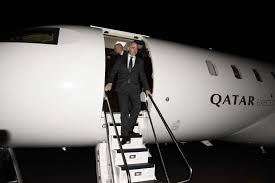















September 24: After weeks of hiding and refusing to face his member associations or governing council members, FIFA president Gianni Infantino has found his jet legs again. He is visiting the Caribbean islands this weekend in a campaign trial as he desperately tries to rally support for his continued presidency.
Infantino is expected to visit Antigua and St Kitts, as well as Jamaica. In the past, a Caribbean bloc vote has been a powerful force in FIFA elections, with the Caribbean often being king and sometimes rewarded for it.
For his part, Infantino is already targeting the Caribbean federations, which he considers a weak link in the global protest over his leadership at FIFA. The Caribbean guys (there’s a girl) look ripe for maneuvering. He has already brought in Gelson Fernandes to help him twist his arms. Fernandes is an unquestionable stalwart who played his national football for Switzerland, and has been appointed director of member associations in the Caribbean, in addition to his similar role in Africa.
Infantino and Fernandes will use every tool in their money belt to harness the support. And if that doesn’t work, the equally dark art surrounding the manipulation of FIFA’s ethics body will come into play, as a former head of FIFA’s Ethics investigative arm told Insideworldfootball, “there isn’t an FA president who doesn’t have an ethics complaint lodged against them”.
Caribbean presidents are well used to this heavy-handed approach and, for the most part, seem to think it’s all part of the game; never mind that the reality is that they are being taken advantage of (bribed) with what is already their own money.
Antigua, St Kitts and Nevis and Jamaica are considered soft targets.
Antigua has a new president in Ickford ‘Nyah’ Roberts who was only elected in May 2026 but wasted no time in throwing his support behind Infantino, including praising him for his “visionary management (which) has indelibly reshaped the world football landscape”. He certainly got the indelible part right, although most would argue that selling all of FIFA’s commercial rights was not a visionary proposition but potentially life-ending.
To be generous, you could argue that Roberts has barely been around long enough to understand the nuances of global soccer politics or what’s at stake here. Still, he wasted no time reaching out for Infantino’s promise of cash from FIFA. Some Caribbean footballing traditions live on: remember the Mohammed Bin Haman vote money scandal?
St Kitts and Nevis welcomed the withdrawal of FIFA’s sell-off plan, but in the next breath remarkably pledged full support for Infantino. In any other area of life, indiscretions like Infantino’s that threaten the entire being of the institution or company would not go unpunished. That the presidents of the federations really believe that this is not a problem is mind-boggling.
Jamaica is a much bigger and potentially more powerful FA, and should be a leader in the region. But the dark side of football politics is something Jamaican president Michael Ricketts is very comfortable with and a language he is fluent in. In that sense, the Caribbean Football Union committee member seems like a perfect partner for Infantino.
Ricketts commented that the $20 million Infantino offered to sign up for the FIFA Forward Enterprise sale sounded good to him, and said they could do a lot with that money in Jamaica. Leaving aside the debate over the ethical and business rationale for selling FIFA’s commercial soul, there remains a trust issue with Jamaica actually receiving the FIFA money, and what Ricketts would do with it once he gets it.
Ricketts has a spotty ethical record that makes him low-hanging fruit for Infantino and his storm troopers.
Ricketts’ first term as President of Jamaica was marked by a 2017 court ruling by the Supreme Court of Jamaica against Ricketts, for derogatory language he used publicly against Ainsley Lowe in a run-off election, suggesting he was homosexual. jamaica criminalizes sexual activity between men of the same sex with sentences that include a maximum sentence of ten years in prison with hard labor.
Lowe, who feared for his safety after Rickett’s comments, sued for defamation and won. Ricketts didn’t care, as he had the presidency he sought. His conviction was brought to the attention of FIFA’s ethics investigators, but no action was taken and no explanation was given as to why it was decided that his homophobic language did not merit a sanction.
During his presidency, Ricketts became synonymous with the spectacular achievement of the Jamaican women’s team qualifying for back-to-back World Cups, the only men’s or women’s team from the Caribbean nation to do so and qualify for the round of 16 in a finals tournament.
That team eventually refused to play for their country en masse when Ricketts clamped down on payments for the 2023 FIFA World Cup. The players said it was typical of his administration’s general lack of respect for the women’s team and Rickett’s lack of funding for the women’s national team, forcing them to self-fund their achievements with Cedilla Marley’s substantial donations.
Rickett’s Jamaican federation within his FIFA scholarship had a specific allocation for the women’s game.
There has been an underlying narrative within some of the Caribbean FAs that they see themselves more aligned with Africa than within their own geographic region. Their belief is that somehow Africa, which is the poorest, lowest and most subservient of all confederations to the white, European leader of FIFA, will somehow come to support them with riches beyond their wildest dreams.
The reality is that Africa has no money. The Caribbean heritage may be rooted in Africa, but the biggest financial opportunity certainly isn’t. And neither is the wider opportunity for their countries and their footballing ecosystems, even if some of them are minuscule.
are you back
The Caribbean and its soccer executives were a major target of 2015 indictments by the US Justice Department in the FIFAgate case. Having lived through this crisis, Caribbean nations are potentially thrust into another, and one that is institutionally far more threatening to world football than FIFAgate.
In 2015, FIFA and its members found unity in the face of adversity, and Concacaf emerged as an entirely different entity built to serve the game and its members rather than the people running it.
In 2026 the stakes are higher for the Caribbean nations as this time it is about the future of the entire international game and their place in it: get it wrong and they could find themselves isolated and impoverished as Europe in particular turns its back on its countries and players. For those whose national and footballing economies are still closely tied to the funding of their former European masters, the impact could be nuclear.
The leaders of UEFA, AFC and Concacaf have already indicated that each FIFA member association could easily be paid $10 million from existing reserves, and have called on Infantino to support the proposal.
Infantino has remained silent on this proposal, as have African and South American leaders.
So what is really going on here?
FIFA has come out of the men’s World Cup with the highest revenue of all time at $16 billion. This money is largely due to the remarkably complacent nature of Concacaf which persuaded FIFA to award the event to the three largest economies in the region and, after inviting them to the table, allowed FIFA to eat its lunch.
If the Caribbean nations are unable to make an informed decision based on what is good for the long-term future of the game and the generations that will follow in their own countries, they should consider which side their bread is truly buttered on. What is good for them right now?
Unfortunately, with too many Caribbean presidents when you boil it down, it’s all about the money, and what does it mean to them?
That’s about $10 million guaranteed in hand, distributed from money recognized as owned by FIFA, better than vague and half-baked promises delivered on a plane by high-flying executives spending their grant money to do so.
Which side of history do they want the Caribbean nations to be seen on. It’s a pretty big decision for everyone.
Contact the writer of this story at paul.nicholson@insideworldfootdance.com