










































Players: Rafael Nadal and Ivan Ljubicic
- Rafael Nadal. Junior star and new Roland Garros champion
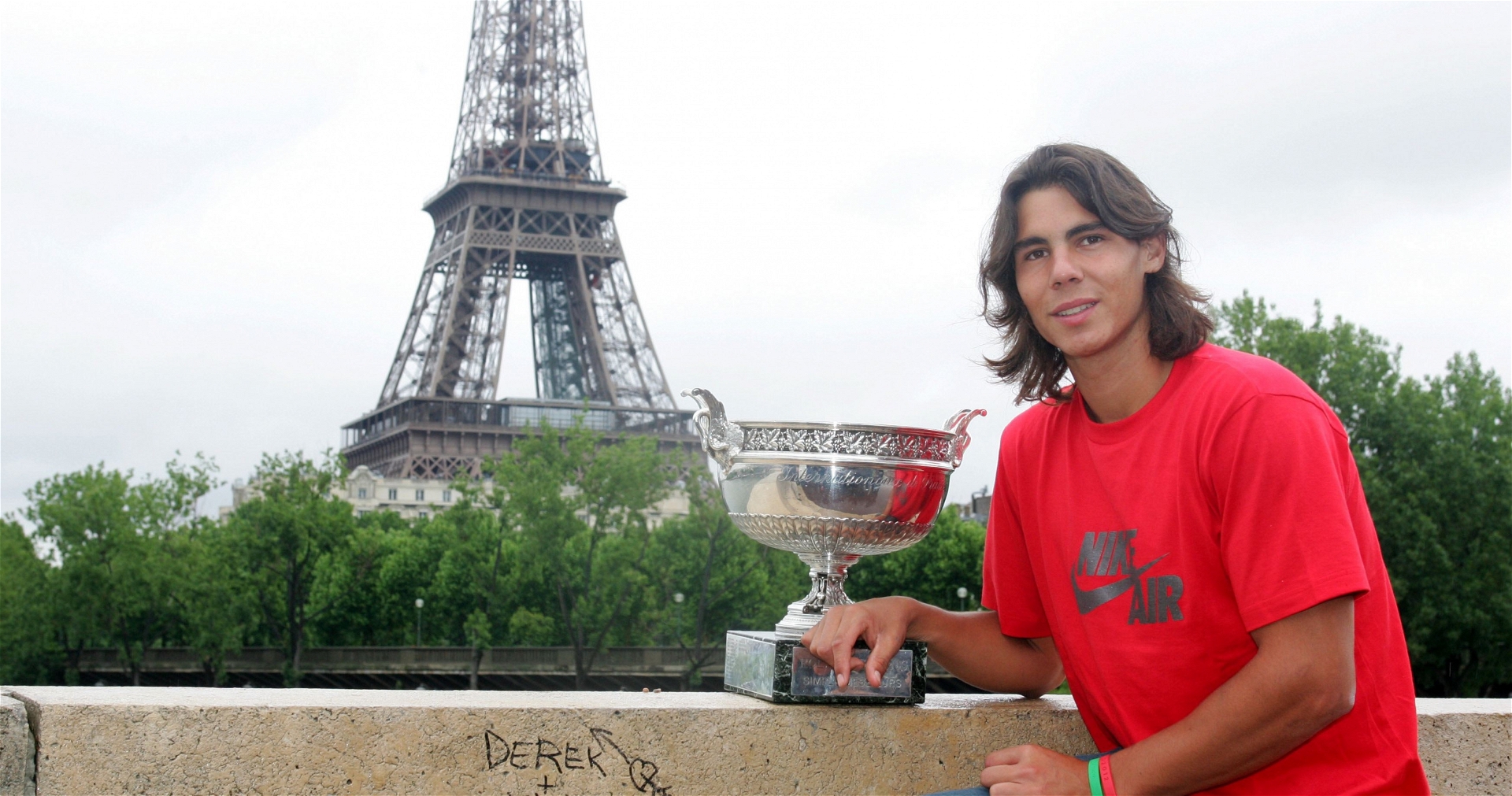
In October 2005, Rafael Nadal was only 19 years old, but reaching the final of the Masters 1000 in Montreal was no surprise. he was already number 2 in the world. A few months ago, ranked 31st in the world, he reached the final of the Miami Open, where he forced world No. 1 Roger Federer to a 2-7 set 6, 6-6, five-set duel. 7-6, 6-3, 6-1. Later in April, he won his first Masters 1000 tournament in Monte-Carlo, defeating the former. Roland Garros runner-up Guillermo Coria (6-3, 6-1, 0-6, 7-6). The following week, he remained unbeaten in Barcelona, defeating Juan Carlos Ferrero (6-1, 7-6, 6-3) in the final round to enter the top 10 for the first time in his career.
Bursting with confidence in Rome, he continued his winning streak to outlast Correa in the longest ATP final ever played (6-4, 3-6, 6-3, 4-6, 7-6). These incredible results made him the favorite to make his first appearance at Roland Garros. This new pressure did not deter Nadal, who won the tournament at his first attempt, defeating Roger Federer (6-3, 4-6, 6-4, 6-3) in the semifinals and Mariano Puerta (6-7, 6-3, 6-1, 7-5) in the final. Now the world number 3 did not achieve any remarkable results on grass, and then Wimbledonhe remained in Europe to compete in and win two clay tournaments, in Bastad and Stuttgart.
In August, Nadal won his first title on hard courts. In the final of the Montreal Masters 1000, he defeated the 35-year-old and still world number 7 Andre Agassi in a clash of generations (6-3, 4-6, 6-2). It was a milestone for Nadal, proving to the tennis world that he can win major events on surfaces other than clay. After an unfortunate loss against James Blake US Open: third round (6-4, 4-6, 6-3, 6-1) the Spaniard won for the second time in Beijing on hard courts (beating Coria 5-7, 6-1, 6-2).
- Ivan Lubicic. A big serving croatian
Ivan Ljubicic, from Croatia, was born in 1979. Relying on a huge serve, he broke into the top 100 in 1999 and won his first title in 2001 in Lyon after defeating Younes El Ainaoui in the final (6-3, 6-2). He remained a top 50 player until 2004, when he climbed into the top 25 after reaching the semi-finals of the Masters 1000 twice, but 2005 was his breakthrough year. Ljubicic reached the finals in four of his first six tournaments, losing to Federer in Doha (6-3, 6-1), Rotterdam (5-7, 7-5, 7-6) and Dubai (6-1, 6-7, 6-3) and another to Joachim Johansson in Marseille (7-5, 6-4). When the Madrid Masters 1000 began in October, the Croatian was ranked 12th as he won back-to-back titles in Metz (defeating Gael Monfils, 7-6, 6-0) and Vienna (where he beat Juan Carlos Ferrero 6-2, 6-4, 7-6).
Location: Madridnot Caja Magica yet
The Madrid Masters 1000 was established in 2002, taking the place previously held by the Stuttgart Open. It was held indoors at the Madrid Arena, a venue that opened in 2002 and had a capacity of 12,000. Past Madrid Masters 1000 champions were Andre Agassi (2002), Juan Carlos Ferrero (2003) and Marat Safin (2004).
Facts: Nadal comes back to 3-6, 2-6
2005 final Masters of Madrid 1000 was a clash between two players who just had their breakout year. Rafael Nadal had started the year ranked 51st in the world and he was now the world number 2 having already claimed no fewer than nine titles including Roland Garros. His opponent, world number 12 Ivan Ljubicic, was aiming to break into the world’s top 10.
The Croatian had a style of play that was perfect for indoor hard courts. In fact, during the past weeks, he even managed to hold his serve for 81 games in a row. At the start of the final against Nadal, he relied on that powerful weapon for a perfect start. He didn’t give the Spaniard enough time to find his pace and soon Ljubicic took a two-set lead 6-3, 6-2.
I would rank this as my most important win of the year after Roland Garros.
Rafael Nadal
However, Rafa had no intention of giving up. Pushed on by the home crowd, he clawed his way back, showing his famous fighting spirit. His passing shots became more accurate, his topspin forehand heavier and forced the Croatian to take a step back. Taking the next set (6-3, 6-4), Nadal pushed his opponent to the fifth set.
In the fifth set, Ljubicic broke first and took a 2-0 lead, but he was immediately broken back. Both players then held their serves until the deciding tiebreak, where Nadal took an early lead to win 7-3. Despite the fast conditions, despite Ljubicic’s 32 aces, despite losing two sets, 19-year-old Rafael Nadal was the new champion of Madrid. That was his 10th title of the year.
“I would classify this as my most important victory of the year after Roland Garros,” Nadal said. “In the first sets, he was playing incredible tennis. How many aces did he serve? 32:00 I couldn’t even see the ball.”
As always, the Croatian kept his sportsmanship, declaring: “It was a great feeling to play here and I’m really happy for Rafa because he’s young and has a lot of wins ahead of him.”
What next?? Nadal struggles with indoor tennis
Rafael Nadal, improving his game every year to win on all surfaces, will claim two Grand Slam titles on grass at Wimbledon and five on hard court, two at Roland Garros, in addition to his 14 Roland Garros titles. Australian Open (2009 and 2022), and four at the US Open (2010, 2013, 2017, 2019). However, he would always remain vulnerable on indoor courts, and the 2005 Madrid Open was his only reputable success in these conditions.
Later in 2005, Ljubicic led Croatia to their first ever Davis Cup, defeating Slovakia (3-2) in the final. He would go as high as World No. 3 in 2006. That year, he would reach the quarterfinals at the Australian Open and the semifinals at Roland Garros, which would remain his best Grand Slam performance. The Croatian would go on to win his biggest title in Indian Wells in 2010, defeating Andy Roddick (7-6, 7-6) in the final. After retiring in 2012, Ljubicic would become a coach, working with Milos Raonic and then Roger Federer.