

































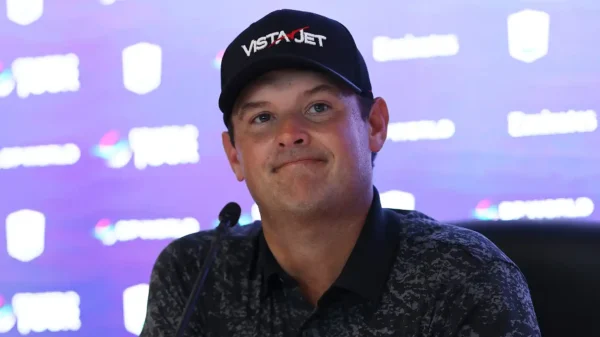
































It’s the latest episode of Tour Validated – hanging with Ping’s Hunter Mahan and Kenton Oates at Trinity Forest – things are getting pretty wild.
If you watch the video below, the core takeaway is right in the title. Even when you’ve played at the highest level in the world like Hunter did, it’s easy to stay locked into what you know. Or, better said, what you he thinks you know.
But after spending a couple of hours hitting everything in the current Ping iron line—stepping outside of his comfort zone—Mahan showed exactly why shaking up your assumptions can completely change how you see the game.
“>
The Blueprint line: T vs
We started right where Hunter lives, looking at the player’s irons. Hunter’s game setup is the Blueprint S, which is arguably the most popular iron on tour right now. But we kicked things off with the Blueprint T – the traditional muscle blade that instantly sent Hunter flashing back to high school memories of old school blades and classic setups.
The biggest surprise with the T iron wasn’t just the clean and simple look of the address – it was how it interacted with the turf compared to older traditional blades. Hunter noted that older players’ clubs could feel strong and unforgiving if you didn’t have a massive, downward swing. These new T models are better for turf.
When we got on the launch monitor with the 6 iron, the numbers showed what was going on under the hood. The Blueprint T felt like absolute butter, but when we moved to the Blueprint S gamer, the S gave about 600 to 700 RPM more spin. For a shallow player who sweeps off the turf rather than taking massive dives, that extra spin is non-negotiable. Without it, the window goes down, doubt creeps in, and your brain starts subconsciously manipulating your swing to compensate. The AT is a gorgeous, modern forgiving blade with smart weighting to help mishits, but the S is made precisely to their needs because of that crucial spin window. Like the wedges, there is also the right iron sole for every player. This is an example of it. That is to say that the T is a lower spinning head, and it is spinning lower for Hunter because of the way it delivers the club. For some players, the T spins a lot more than the S.
It’s mad science, folks!
Moving on to technology: i240
Later, we moved on to the i240. This is where you start to see a bit more offset and a bit longer blade length.
Hunter’s initial reaction was visual – he’s used to a shorter heel-to-toe profile with a high pinched toe, so looking at something a little more rounded takes a bit of an adjustment. But when it started to hit, the engineering story told. The i240 launches a couple of degrees higher than the Blueprint series and takes to the air effortlessly.
The real magic of an iron like this is what happens on a miss. When Hunter got hit in the face, the i240 saved him. It lost just a little bit of speed, and the spin rate was right where it should have been. It’s an iron built to preserve your numbers when your strike isn’t 100% pure, giving you high-flying consistency without feeling bulky. Think game improvement for Tour players and low handicappers – that’s the i240.
The Rocket Launchers: i540, G440 and G740
Then things got saved. It fell into the i540, the G440 and finally pushed all the way into the max-forgiveness G740s, and Hunter has officially entered a new dimension.
View Product
When Hunter hit a 9-iron in the i540, he hit an astonishing ball speed of 124 mph — about 9 mph. faster than his standard setup – with the loft of a traditional 8 iron. He looked at us laughing and joked, “Does it look bigger? I need three 9 irons and just change the lofts every two degrees!”
This is where understanding the loft progressions throughout Ping’s line completely changes how you think about golf clubs. If you look at those numbers, the lofts get progressively stronger as you move into the distant households. But Ping’s engineers didn’t just handle the lofts and let the ball hit the ground. They build in wider soles, lower and deeper center of gravity and extra length in the long irons specifically to counter that strong loft.
Kenton and I laughed on the range because normal golfers are so caught up in looking at the number printed on the bottom of the club. They see a 7 iron or a 9 iron and think it must fly a certain way based on what they played 20 years ago. But as Kenton pointed out, these stronger clubs are designed to launch much higher and enter their window instantly and FAST.
In many cases, if you take a traditional tour-style loft and send it back into these high-tech distance tests, the ball will literally shoot straight to the moon and settle out into the wind.
When Hunter hit the ultra-wide-sole G440 and G740, club heads did all the heavy lifting to control the low point and launch the ball effortlessly. Even though the lofts were cranked compared to their gamers, the ball was still above 120 feet in the air with a lot of stopping power. As Hunter put it while testing the wider soles and game-improving shapes, the club doesn’t want to dig in — it just sweeps over the turf and allows the technology to launch the ball cleanly.
The Story of Loft: How numbers change across the board
When you look at how Ping designs these sets, you can see how the lofts change dramatically as they move from players’ irons to the families of distance and game improvement. In the player-focused Blueprint T, Blueprint S and i240 sets, a standard 6 iron sits at 29.5 degrees of loft, while the 9 iron comes in at 41.0 degrees.
As you move outside of that player category, those lofts begin to drop aggressively to pump up ball speed (some call this loft jacking but it’s not that simple). In the i540, the 6-iron straightens at 25.5 degrees and the 9-iron sits at 37 degrees. Step into the G440, and the 6 iron is also at 25.5 degrees with the 9 iron at 37.0 degrees. Finally, pushing up to the max-forgiveness G740, the 6-iron drops even further to 24.5 degrees and the 9-iron drops to 36 degrees. No wonder the ball goes so far, look at the loftsmany people say. But if you pay close attention to what Kenton mentions in the video, it’s by design. Those irons are designed to keep speed in the window as swing speed slows with things like age and injury.
So is it ego? No. Look more like a fountain of youth, attached to your gapping, throw and carry distances that you are used to as long as humanly possible. It is not a crime.
Quick Comparison: Iron Lofts by Model (6-iron and 9-iron)
- Plan T
- 6-Iron: 29.5°
- 9-Iron: 41.0 °
- Blueprint S
- 6-Iron: 29.5°
- 9-Iron: 41.0 °
- 240
- 6-Iron: 29.5°
- 9-Iron: 41.0 °
- i540
- 6-Iron: 25.5°
- 9-Iron: 37.0 °
- G440
- 6-Iron: 25.5°
- 9-Iron: 37.0 °
- G740
- 6-Iron: 24.5°
- 9-Iron: 36.0 °
The Big Takeaway
The biggest lesson of the whole day was not just knowing what won on a Trackman. It was about taking ownership of your wallet and staying OPEN MINDED.
Hobbyists often buy clubs based entirely on what looks cool or what a friend plays, without really knowing what their non-negotiables are or what each tool in the bag is really supposed to do to help them. Mahan did not to get to test each club in the lineup; he could have just walked away saying his current setup works.
But taking the time to try everything proves that the game is not about the number printed on the sole of your iron; it’s about getting to that place where the tool in your hand helps you create the shot you want to hit more often than not. Technology isn’t there to feed our egos, it’s there to make our lives easier. Period.
Ready to overhaul your wallet in 2026? Find a suitable club location near you at True Spec Golf.