





























































It also proved to be one of the last notable results of a career that had begun brilliantly before him was the victim in the stabbing incident at the 1993 Hamburg Open.
Players: Monika Seles and Jelena Dokic
- Monica Seles. A teenage prodigy whose career was tragically cut short
Monica Seles was one of the most successful players in the world at a very young age. Her powerful two-handed groundstrokes, her innovative way of hitting the ball surprisingly early and with so much power, and of course her trademark roar, absolutely revolutionized the women’s game.
In 1990, at age 16, he became the youngest player ever to win Roland Garros. That was the start of his dominance on tour. In March 1991, at the age of 17, he became the youngest world No. 1 in tennis history, dethroning Steffi Graf from the throne he had held since the summer of 1987.
Since January 1991, Seles has won seven of the eight Grand Slam tournaments he has entered, losing only in 1992. Wimbledon final, posting a 56-1 win-loss record. Furthermore, she claimed three consecutive WTA titles in 1990, 1991 and 1992.
However, hHis career was brutally cut short on April 30, 1993, during the quarterfinals of the Hamburg Open, when he was stabbed by a mentally unstable Graf fan while changing. It turned out that the psychological wound was much deeper than the actual stabbing. Although Seles was physically ready to play just a few months later, it would be more than two years before he returned to take part in the tour again.
Seles made a successful comeback in 1995, claiming the title in Toronto, proving that she was worthy of her No. 1 ranking by defeating one opponent after another, including Amanda Coetzer (No. 27) in the final (6-0 6-1). A few weeks later he was beaten US Open: final by Steffi Graf in three sets (7-6, 0-6, 6-3). In early 1996, at the age of 22, she won her last Grand Slam Australian Open. In the final, he defeated German Anke Huber (6-4, 6-1).
After that, she remained in the top 10, but suffered from eating disorders and weight problems, which she would later describe: his bookhe never won another Grand Slam title. Seles reached the championship round twice more, at the 1996 US Open (losing to Graf 7-5, 6-4) and at Roland Garros in 1998 (losing to Sanchez 7-6, 0-6, 6-2).
- Elena Dokic. A teenage star from Australia
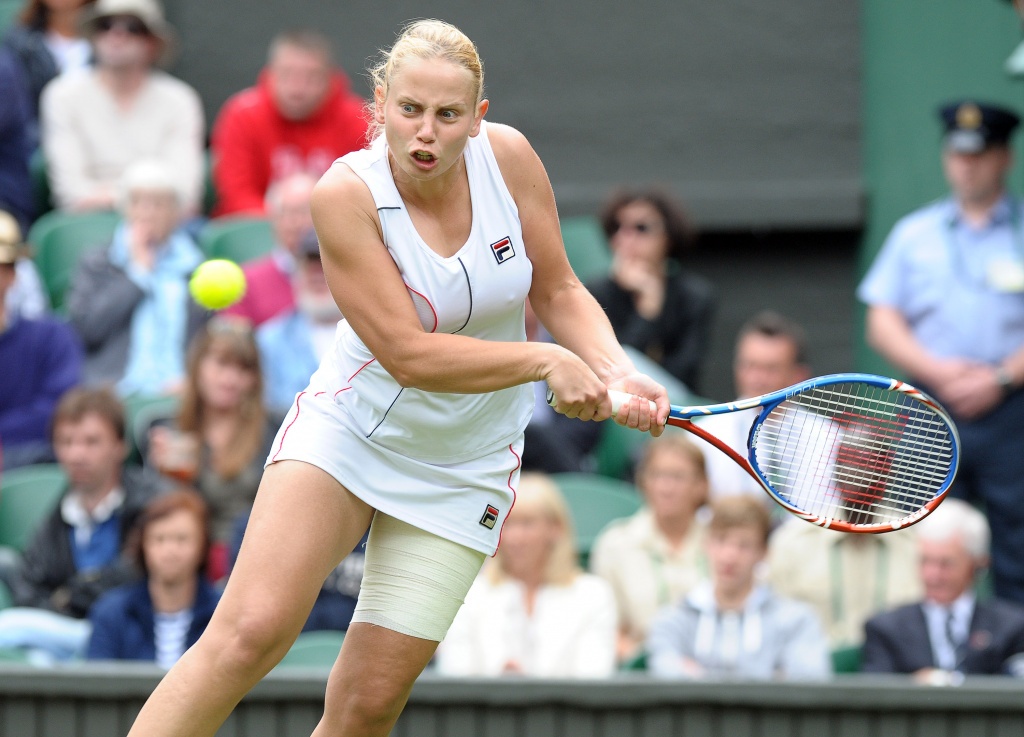
Jelena Dokic was born in Yugoslavia in 1983, but her family moved to Australia in 1994 to escape the civil war, and it was there that she developed as a tennis player. In 1999, aged 16, Dokic scored one of the biggest upsets in Wimbledon history, defeating world No. 1 Martina Hingis in the first round 6–2, 6–0 before reaching the quarterfinals (Alexandra Stevenson won 6–3, 1–6, 6–3).
She finished her first full season on tour as world No. 43, and in 2000 she continued to improve, reaching the semifinals at the All England Club (losing to Lindsay Davenport, 6–4, 6–2) and rising to world No. 29.
The placeSydney Olympic Park Tennis Centre
The Sydney Olympic Park Tennis Center is a tennis and multi-purpose sports facility located in Sydney Olympic Park, Australia. The center was built in 1999 and hosted the tennis events of the 2000 Summer Olympics. Its Center Court, later renamed the Ken Rosewall Arena, had a capacity of 10,500 spectators.
The factsSeles dominates Dokic and wins in straight sets
On September 26, 2000, Seles representing the United States of America and Dokic representing Australia faced each other for the bronze medal at the Sydney Olympics. Seles lost to American Venus Williams (6-1, 4-6, 6-3), and Dokic lost to Russian Elena Dementieva (2-6, 6-4, 6-4).
Dokic, who grew up in Sydney, had the full support of the crowd, while Seles only had her American teammates, including the Williams sisters, to cheer her on. “We had a great women’s tennis team, Venus Williams, Lindsey Davenport and myself (and Serena Williams won doubles gold with her sister). Even though we were rivals, everyone in Sydney supported each other.” Celes would remember after 12 years at Vogue.
Seles hadn’t won a Grand Slam in more than four years, but she struggled to beat only the top players. “She just couldn’t handle beating players like Martina Hingis, the Williams sisters and me,” Olympic teammate Lindsey Davenport said. according to ESPN.com. “He beats them all. He has been working very hard and I hope he can make his progress to get back to the top soon. His movement is a bit of a factor, but when he’s in there, he hits the ball better than anybody.”
Perhaps Dokic didn’t study his opponent’s game enough as he tried to beat Seles from the baseline. As a result, he lost the first three games in six minutes, and after only 23 minutes of play, the former world No. 1 had already taken the first set 6-1. The second set was closer, but in the end Seles broke his opponent at 4-4 and sealed his victory with two consecutive aces.
“I am happy that I won a medal,” he said. “Apart from gold, bronze is good. For me, Grand Slam tournaments are still much bigger, but this is a great honor to represent your country.”
What next? Seles is inducted into the Tennis Hall of Fame
Monica Seles couldn’t win another major title in the following years. Battling a foot injury, she would play her last match ever at Roland Garros in 2003, losing to Nadia Petrova (6-4, 6-0). He will announce his tenure only in 2008 and was inducted into the International Tennis Hall of Fame in 2009.
Jelena Dokic claimed five titles and finished as runner-up six times between May 2001 and July 2002, rising as high as No. 4 in the rankings. Struggling with his abusive father, he would change nationality twice, and his career did not match his promising start. He would never again reach the semifinals of a Grand Slam. After retirement, Dokic will become a leading tennis commentator on television.