























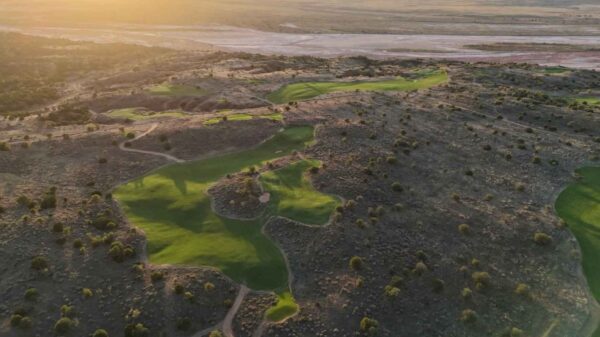































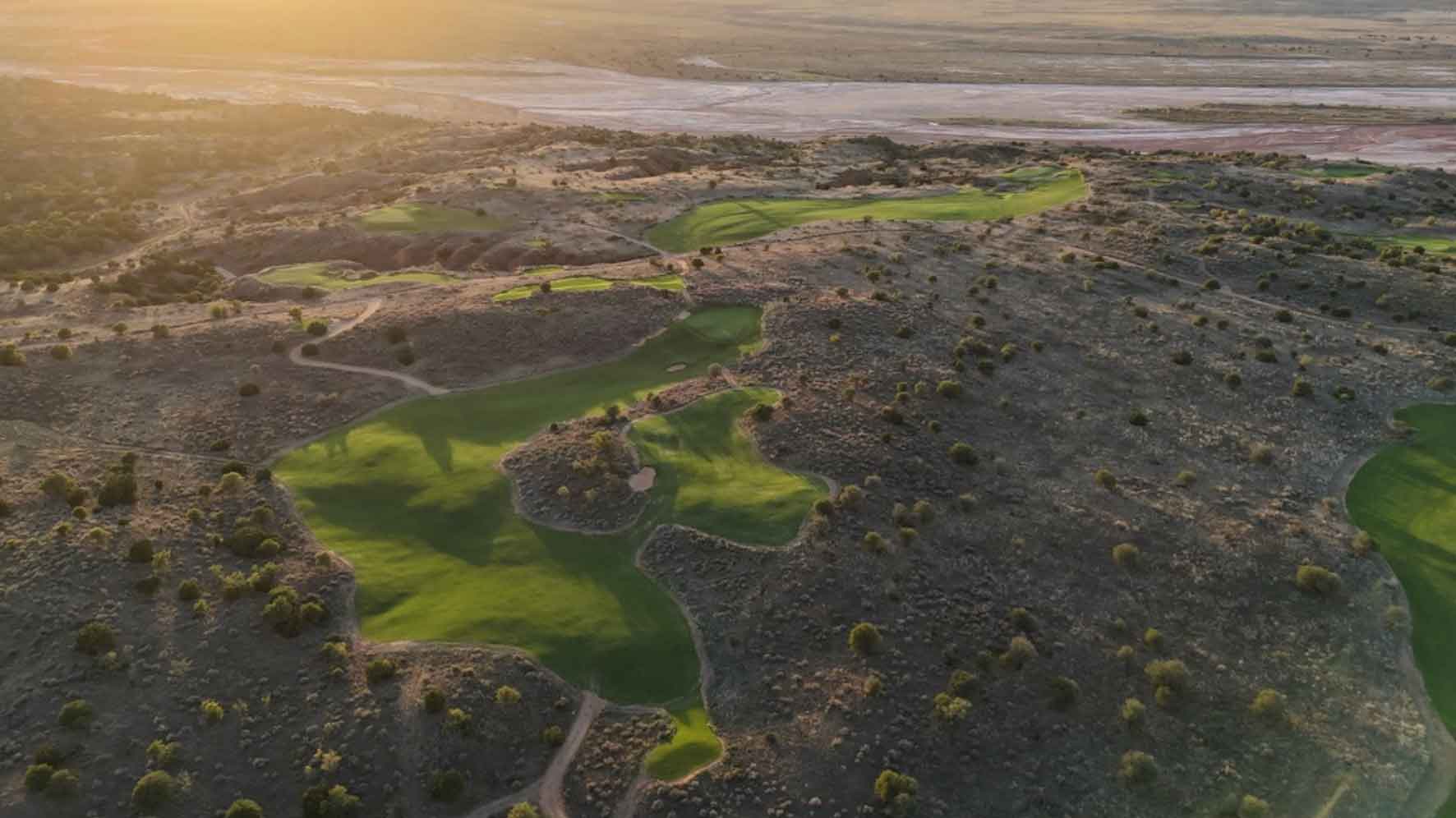
On its curling path through the Texas Panhandle, the Red River cuts through a wrinkled landscape of prickly pear, yucca and mesquite, rugged terrain that wasn’t used for much beyond cattle until a pair of architects arrived.
Tom Doak went first. Gil Hanse followed. Their combined efforts form the core of Childress Hall, a remote destination that stands out on the map with both layouts GOLF’s new US Top 100 list. Not since Streamsong in 2013 — along with Doak’s Blue Course and Coore/Crenshaw’s Red Course — has a single property debuted two new 18-holers on the same list.
Unlike Streamsong, Childress Hall is a private enclave, a three-and-a-half-hour drive from Dallas, the last stretch on lonely dirt roads lined with herding Herefords. At the entrance to the 2,400 acres of former ranchland, a discreet metal gate opens automatically, making way for the complementary parks.
Even by his minimalist standards, Doak’s Upper Course (No. 44) needs little intervention. It treads lightly on undulating terrain, building plays on a new one that skirts the rocks above the ruddy banks of the river. On the par-4 10th, a split fairway forces a choice between a partially blind shortcut to the right or a more forgiving fairway to the left that leads to an uphill approach. The par-3 11th and 13th each have two greens, so you can choose your favorite and change the second round.
A club refrain is that Doak barely moved a few shovelfuls of dirt while Hanse moved heaven and earth to create Low Course (No. 55). It gracefully flows closer to the river, with a more intimate footprint than the Upper that still makes room for large blast bunkers and wide, contoured greens whose steep shoulders slope toward tightly mowed pickup areas. In a nifty touch, three six-hole loops return to a common center, so golfers can squeeze in extra play without straying far from the base.
This is Texas. The wind can blow. While it helps Childress Hall to have a good ground game, there are forced carries. One is the par-3 15th of the Lower, which plays over and over a ravine. It is nicknamed the Purchase, a nod to the river it overlooks, once a boundary of the Louisiana Purchase.
The United States paid $15 million for this deal. From this point of view, it seems a modest price.