Turn back the clock, all the way to 2005. It turned out to be a grand slam season for Wales after an endless drought, 27 years of waiting and longing; but midway through the tournament, nothing seemed less likely.
HSBC SVNS returns to Cape Town this December!
Don’t miss your chance to see the world’s best rugby teams take center stage on December 5-6 in Cape Town.
Halfway through the third round match against France in Paris, Wales trailed 15-6, and it could have been much, much worse. On the back of what France coach Bernard Laporte later called ’10 minutes of madness’ just after half-time, winger Martyn Williams scored two quick tries and Wales unexpectedly hit back to score 18 of the next 21 points to run out reverse winners, 24-18.
The surprises began at the beginning of the week, when it was revealed that the name of the sponsor on the famous red shirts had to be changed. In 2004, Cardiff-based Brewery Brains was accepted as the main sponsor of the rugby team’s jerseys. At the time, Brains bitter was one of the most popular beers in the country, but Évin Law limited the advertising of alcoholic beverages through the Channel.
The law meant that Wales could not wear the brewery’s name on the front of their shirt in Paris. With a wave of a wand and subtle marketing skills, someone came up with a solution, with a sly quip: ‘why don’t you change The brain that Brown?’
Mike Ruddock’s men needed plenty of reserves from both in the last 10 minutes of the game, they were defending for their lives on the goal line for what seemed like an eternity as the home fans rocked the stadium in Saint Denis. France invited scrum after scrum, with the giant William Servat at the epicenter of every push attempt. God knows how, but Rob McBryde and the Welsh scrum weathered the storm, and emerged into the clear air and blue skies of the ‘W’.
Servat was one of the three strongest whores in the world since the beginning of the new millennium. Current scrum coach Ireland national team player, John Fogarty, once told me that he felt his arm go limp just before he passed out in the middle of a fight against Servat, who played for Leinster against Stade Toulouse, such was the pressure exerted by the man with the not-so-playful nickname La Buche (‘Diary’).
The other two were the Springboks – Bismarck du Plessis of the 2010s and current Bokke scrum Atlas, Malcolm Marx. No one who watched the South African destruction of the British and Irish Lions in the first Test of the 2009 series will ever forget it. Du Plessis’ power was such that he forced skipper John Smith into the unfamiliar position of a stiff, but the carnage that Du Plessis and Tendai ‘Beast’ Mtawarira inflicted on the tourists’ other end was still something to behold. The Springboks of that era had strength, and they also had a top brain behind them in the form of scrum-half Fourie du Preez.
Based on the evidence of their previous two Nations Championship games against France and Ireland, the world champions lost the balance between brawn and brain. The Marx-based scrum strength remains, but there is little or no intelligence behind the key positions of option-taking and full-back play. There is no Du Preez or Willie le Roux to give the South Africans shape with the ball in hand. It may be temporary; it can be time consuming. But right now, it’s an undeniable fact of life.

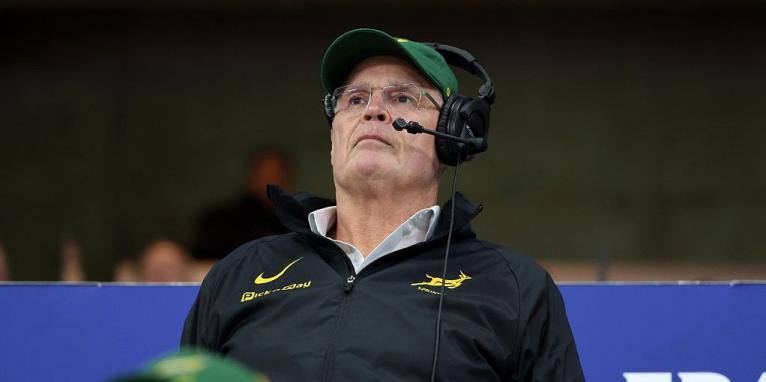
And that’s why Rassie Erasmus’ latest messages against the officiating are nothing more than a smoke screen, designed to camouflage the re-engineering of the team that is needed behind the scenes. Erasmus is the first coach in history to realize that it is entirely possible to double up as a top head coach and a major social media influencer, but the irony of his complaints is that Erasmus mostly got the play he wanted from referee Andrea Piardi in Paris.
South Africa won the lion’s share of the penalties, 14-11 in a high-penalty game, with scrums providing eight of those penalties. That’s the kind of statistic that won the Springboks the RGR series. In Dublin under the patronage of England’s Christophe Ridley, the Boks were also awarded 10-8 penalties on aggregate and scrum penalties three to one, with South Africa conceding two more turnovers with a free-kick on an opposition cross while not conceding a single one. If you’re outscoring penalties 24 to 19 and scrum penalties/misses 13 to one, there’s really no reason to blame the officiating for your lapses.
A potential problem for South Africa at next year’s World Cup is that their opponents are finding solutions to their problems faster than the Springboks are able to rediscover their lost balance between brawn and brains. This time last year, Ireland had conceded nine penalties and two yellow cards in the match, and at the weekend the deficit was reduced to two penalties and no yellow cards.
First to Paris. France found a workaround in their game management that overcame the Springboks’ scrum dominance. Unlike the English Prem umpires in the fourth round, Piardi only asked for ‘shoulders’ from both loose-headed props in the first set-figure, without repeating the instructions at each jerk. When the scrums turned left, it simply rewarded the feeding team, which was always South Africa. The turning point came between 63rd and 69th minutes.
https://t.co/UqQlYccYcS
— William Bishop (@RPvids1994) November 19, 2026
https://t.co/M1pRRuCCAb
— William Bishop (@RPvids1994) November 19, 2026
On the first reset, Springbok tighthead Wilco Louw is drawn in and down the center of the tunnel. At the second asking of the question, the scrum lasts a full eight seconds and Les Bleus end up the more dominant of the two, throwing the South African front row at their collective back.
Some neutrals would be reassured that the Springboks were lucky, as the scrum was a close copy of the critical turning point in the opening Test of the Greatest Rivalry series, when a penalty was awarded to the defending side in very similar circumstances.
https://t.co/SASXW3up2T
— William Bishop (@RPvids1994) August 23, 2026
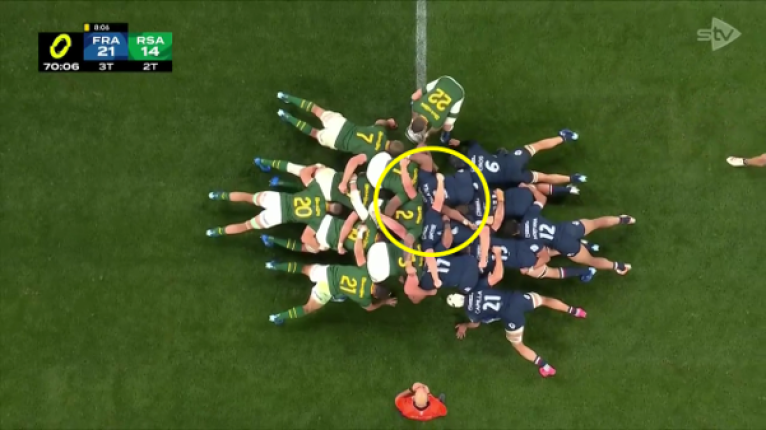
The domino effect of the Springbok penalties saw Frenchman Regis Montagne yellow carded, and he duly received his marching orders on the very next face-off. This in turn meant that Sipili Falatea had to return ‘cold’ after a full 50-minute shift on the spot, and it cascaded into one truly dominant South African display of the match.

https://t.co/O5LEifL6FE
— William Bishop (@RPvids1994) November 19, 2026
Falatea and his whore Maxime Lamothe try to get into Malcolm Marx, but Bulls the new rake is too powerful and drills the gap between them while the UBB solid head rolls 90 degrees. Fair enough.
Where France looked to pinch Marks to limit his effectiveness, Ireland’s plan in Dublin was to introduce Tadhg Furlong slightly ahead of his two clubmates in the front row, and crab on the right to stop Ox Nche walking around their solid head.
https://t.co/LLwsQFcYPL
— William Bishop (@RPvids1994) November 22, 2026
Unlike the same game in November 2025, the men in green were never demoralized or dismantled on stage, and enjoyed their moments of success against opposing players.
https://t.co/X4m4aStwQD
— William Bishop (@RPvids1994) November 22, 2026
https://t.co/wJBFdJy86h
— William Bishop (@RPvids1994) November 22, 2026
Although Andrew Porter was penalized for a walk in the second inning, he clearly got the hit against Wilco Louw and could be considered unlucky with the outcome. If Ireland give the ball away, they are likely to be awarded a penalty under the current referee ‘rules of engagement’.
One occasion where Porter lost a moment in the ‘set’ resulted in a failed try for South Africa.
https://t.co/TKW5EjLrTy
— William Bishop (@RPvids1994) November 22, 2026
But when the ball went outside the set-piece, there was little comparison between the alertness and ingenuity of the two sides.
https://t.co/VIm7An2T3s
— William Bishop (@RPvids1994) November 22, 2026
Having recovered the ball from a contested kick, South Africa can think of nothing better than to kick it aimlessly, in stark contrast to Ireland’s slick handling and keen awareness of the ensuing kick return. Powers abound, but no brains behind them.
The last time the Springboks suffered back-to-back defeats against Ireland and France was in November 2022. It sparked another officiating outburst by Erasmus a year before the World Cup, with World Rugby’s elite referees boss Joel Jutge complaining about the Springbok coach using social media to air his grievances.
Four years later, the pattern repeated itself, but this time the Springboks lost to the same opponents while looking devoid of attacking spark. If the Boks lose the Nations Championship final to France – their third defeat on the bounce – Jutge’s question – “What will be done to get (Rassie Erasmus) to stop? I don’t know” – may have been answered, without words, but by the action of his own team.