The players involvedRoger Federer and Fernando Gonzalez
- Roger Federer, Swiss genius, undisputed world number 1
Federer started 2007 on a winning streak Australian Open without dropping a set, defeating Fernando Gonzalez (7-6, 6-4, 6-4) in the last round. He then had a unique Indian Wells/Miami tour where he lost twice against the same player, Argentina’s Guillermo Canas, who was returning to the tour after being suspended for using a banned substance. Returning to form later in the spring, Federer triumphed in Hamburg, defeating his Spanish foe for the first time on clay in the final (2-6, 6-2, 6-0). At the French Open, however, Nadal defeated him again in the final. The Swiss got his revenge on the lefty Wimbledonwhere he won the final in five sets (7-6, 4-6, 7-6, 2-6, 6-2) and secured his No. 1 ranking by winning at Flushing Meadows, defeating Novak Djokovic in the final (7-6, 7-6, 6-4).
26-year-old Swiss prodigy Roger Federer has been world No. 1 without a break since February 2, 2004. US Open: (2004, 2005, 2006, 2007). In 2006, his best year, he won 12 titles, including three Grand Slams, a Masters Cup and four Masters Series. He had 92 wins and only five losses, four of which were against his only serious rival at the time, Rafael Nadal. The main reason Federer didn’t win was the Spaniard French Open Championship yet; he lost to him in the semifinals in 2005 (6-3, 4-6, 6-4, 6-3) and in 2006 (1-6, 6-1, 6-4, 7-6) and in the final in 2007 (6-3, 4-6, 6-3, 6-4).
- Fernando Gonzalez. Chile’s heavy center forward

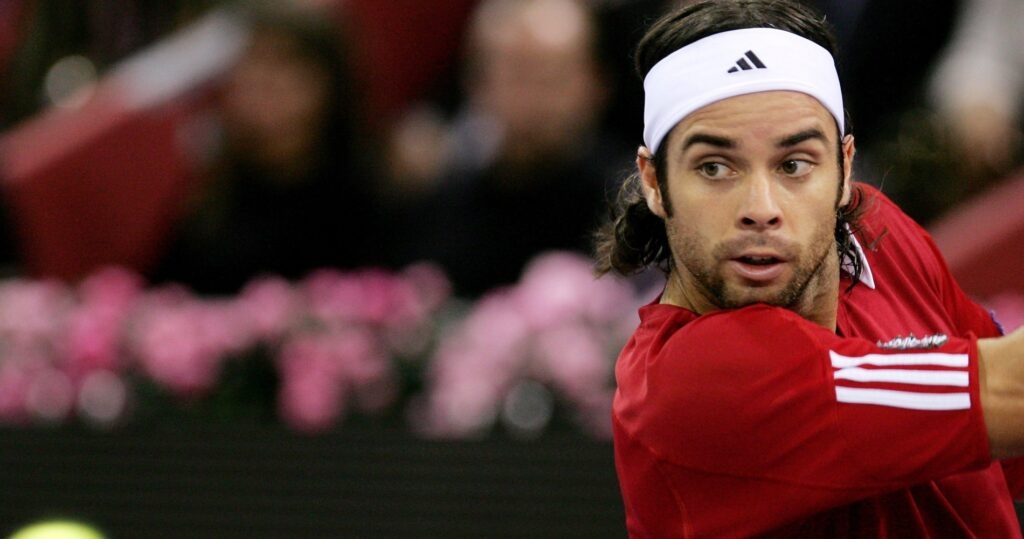
Fernando Gonzalez was born in 1980 in Santiago, Chile. He turned professional in 1999 and achieved his first major success in 2000 when he won his first ATP title as the 352nd in Orlando (defeating compatriot Nicolas Masu 6-2, 6-3 in the final). His game was built around his powerful forehand. Despite his success in Orlando, he was not consistent at the top level until 2002. He won two more ATP titles in Vina del Mar (defeating Nicolas Lapenti 6-3, 6-7, 7-6 in the final) and Palermo (defeating Jose Acasuso 5-7, 612-3, in the quarterfinals. 2002 US Open, where he defeated Sheng 6-7, 6-3, 6-3, 6-7, 7-6 to Shalken.
In subsequent years, Gonzalez remained a top 25 player, reaching the quarterfinals of Roland Garros in 2003 (lost to Juan Carlos Ferrero 6-1, 3-6, 6-1, 5-7, 6-4) and Wimbledon in 2004 (lost to Federer 7-6, 7). In 2006, reaching the semifinals of three Masters 1000 events (Monte Carlo, Toronto and Cincinnati) put him in the top 10 for the first time in his career. In 2007, Gonzalez finished runner-up at the Australian Open (lost to Federer 7-6, 6-4, 6-4). It gave him a career-high ranking of world No. 5. Also finishing second to Rafael Nadal at the Masters 1000 in Rome, the Chilean qualified for the year-end Masters Cup despite first-round losses at Roland Garros and the US Open.
The placeQizhong Forest Sports City Arena, Shanghai
Established in 1970, the year-end Masters Cup was the annual final meeting of the eight best players in the world. Originally held at a different location each year, it was housed in New York’s Madison Square Garden from 1977 to 1989. Since then, the tournament has moved again several times: Frankfurt (1990-1995), Hanover (1996-1999), Lisbon (2000), Sydney (2001), Shanghai (2001). (2003-2004), then returned to Shanghai in 2005. With only the top eight players of the year qualifying for the event, its list of past champions is nothing short of impressive.
The factsGonzales turns the match around for the win
In November 2007, Roger Federer seemed almost invincible. For the past four years, the Swiss has dominated the game like no one before him. Since his shocking loss in the first round at Roland Garros in 2003, Federer has won 12 Grand Slams and 45 tournaments overall. In both 2006 and 2007, the Swiss was just one match away from winning a calendar Grand Slam, only to lose in the Roland Garros final to his only serious rival, Rafael Nadal. Roland Garros 2003 was also the last time until now that Federer lost two in a row.
When Federer landed in Shanghai to play the Masters Cup in 2007, he was the reigning champion and a heavy favorite for the tournament. The only player to beat him since the US Open was David Nalbandyan, and despite beating the world No. 1 in both Madrid and Paris, the Argentine did not win the Masters Cup. So, despite losing to Nalbandian in the quarter-finals in Paris (6-4, 7-6), not many observers thought Federer was taking a risk in his first round match against Fernando Gonzalez, whom he had beaten in their first 10 meetings.
However, after Federer took the first set 6-3, the Chilean went into “God” mode, hitting winners in every direction. For the first time in 11 matches, Gonzalez was able to take two straight sets against the world No. 1, eventually winning 3-6, 7-6, 7-5. In the deciding set, Federer was unable to convert any of five break points, mainly thanks to his opponent’s excellent hitting.
“I just thought the shots he was making were funny,” Federer said. Reuters:. “You have to give him credit for that.”
“I was telling my coach in the locker room that no one has ever beaten me 11 times in a row,” Gonzalez joked. “I scored three incredible points to break him at 5-5. The last two games were the highest of my level. What was important was my serve and not being afraid to hit.”
After losing in the quarterfinals in Paris, it was the first time in four years that Federer had lost two straight on tour.
What next?? Federer came back to win the Masters Cup
On the back of this stunning first match, Gonzalez would lose his next two round robin matches against Andy Roddick (6-1, 6-4) and Nikolay Davydenko (6-4, 6-3).
Despite losing to Gonzalez, Federer won the Masters Cup for the fourth time.
However, Federer would never dominate the tour the way he did from 2004 to 2007. In fact, after losing to Novak Djokovic in the semi-finals of the Australian Open in 2008, the Swiss lost to Rafael Nadal in the finals of Roland Garros and Wimbledon 1 and robbed him of the world on August 1. This ended an unbroken reign at number one for 237 weeks (an all-time record). When he retired in 2022, Federer had won 20 Grand Slam titles, the first player in tennis history to reach the milestone, but was eventually surpassed by rivals Nadal (22) and Djokovic (24).