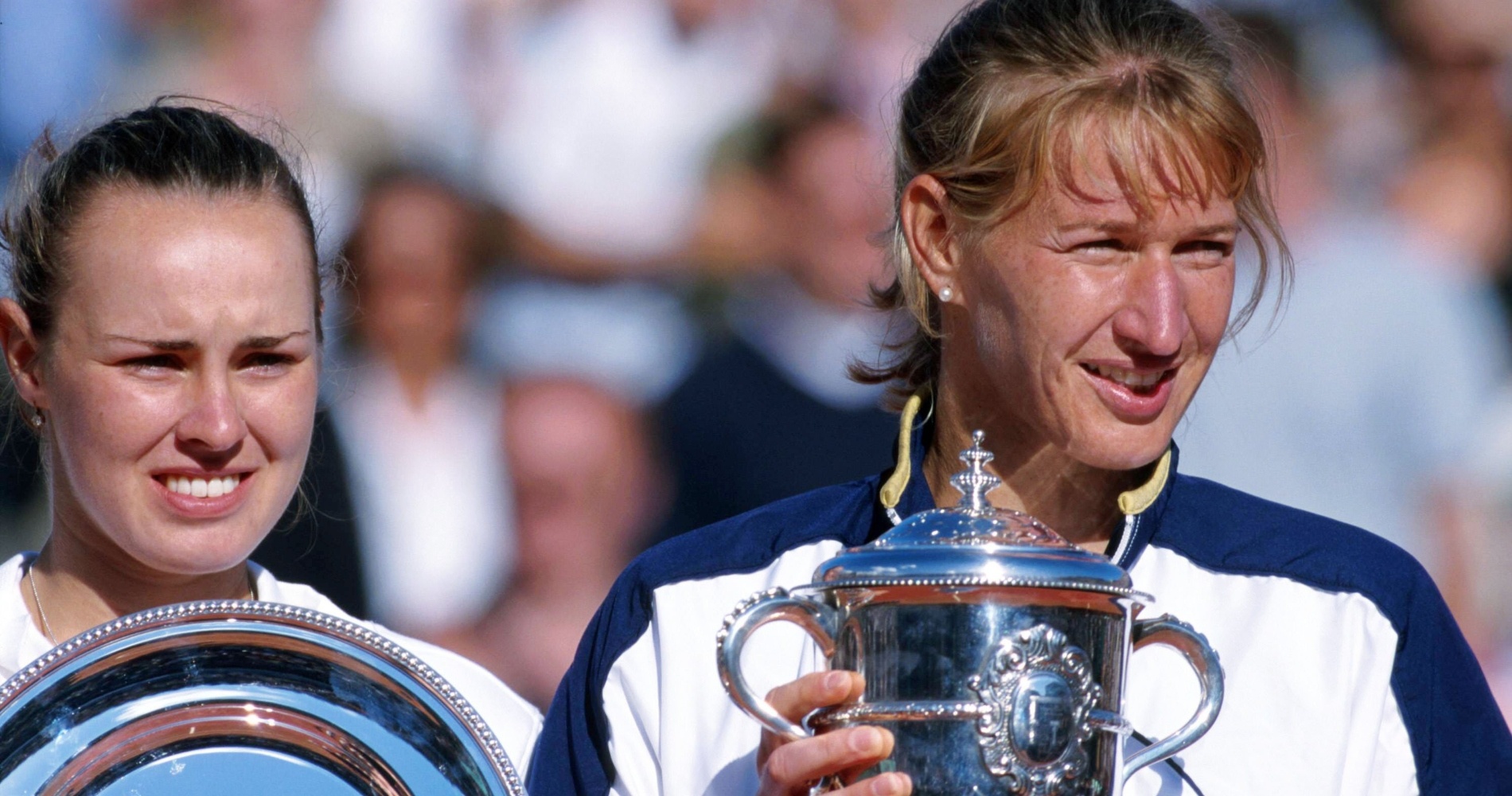
The playersLindsay Davenport and Martina Hingis
- Lindsay Davenport. Big hitting American With three Grand Slam titles and an Olympic gold
Lindsey Davenport was born in 1976 in the USA. He turned professional in 1993, and that season he won his first title at the Swiss European Open. she reached the fourth round of the US Open and defeated world No. 6 Gabriela Sabatini (6-4, 6-2) in Philadelphia to finish the year as world No. 20. The Argentinian described Davenport’s playing style in simple words.
In 1994, Davenport broke into the top 10 and finished second at the Masters Cup (losing to Sabatini 6-3, 6-2, 6-4), but in 1995, troubled by family issues, he fell out of the top 10. The following year he worked hard to achieve his fitness title. Games where he defeated Arantkha Sanchez in the final (7-6, 6-2).
In 1997, Davenport excelled, winning six tournaments, including Indian Wells, and she reached the semifinals at the US Open, defeating Martina Hingis (6-2, 6-4). In 1998, she took her career to the next level by reaching the semifinals of two Australian Opens (losing to Conchita Martinez 4-6, 6-3, 6-3) and Roland Garros (lost to Arantkha Sanchez, 6-3, 7-6) before winning her first Grand Slam title in New York, where she beat Hingis in the final (6-3, 7-5). Shortly after this victory, he reached world No. 1 for the first time. In 1999, he won his second major Wimbledonsurpassing Steffi Graf in the final (6-4, 7-5). In November, he ranked 2nd in the world.
- Martina Hingis: Miss Switzerland, teen sensation and the youngest #1 in history
Martina Hingis was born in September 1980, and her mother, Melanie Molitor, named her after tennis legend Martina Navratilova. Tutored by his mother, he soon became a prodigy of sorts, winning the junior tournament at Roland Garros at the age of 12. He began playing on tour at age 14, but was only allowed to play 15 tournaments until he was 16, a rule he vehemently protested; “How can I like that?“
Hingis’ game was based on extraordinary hand-eye coordination, excellent tactics, amazing touch and great anticipation. Early in his career, he was said to lack power and a decent second serve. His breakthrough year came in 1996. She reached the semi-finals after defeating undisputed world No. 1 Steffi Graf at the Italian Open in May. US Open:where Graf beat him 7-5, 6-3 and he finished runner-up. season-ending WTA Tour Championship (Lost to Graf, this time in five sets: 6-3, 4-6, 6-0, 4-6, 6-0).
Three months after her 16th birthday, Hingis was already ranked sixth in the world, and in January 1997, she became the youngest Grand Slam champion in tennis history, defeating Mary Pierce (6-2, 6-2) in the final. In the months that followed, she won no fewer than eight titles, including Wimbledon (defeating Jana Novotna, 2-6, 6-3, 6-3 in the final) and the US Open (defeating Venus Williams, 6-0, 6-4). He also reached the final of Roland Garros (lost to Iva Majoli 6-4, 6-2). These outstanding results made him the youngest player ever to reach world No. 1 in March at the age of 16 years and three months.
In Melbourne in 1998, Hingis added a fourth Grand Slam crown to her list of achievements, but in the following months she failed to reach a major final until the US Open, where she finished runner-up to Davenport (6–3, 7–5), and she temporarily lost the No. 1 ranking. In 1999, he won the Australian Open for the third time, but he suffered a dramatic loss to Graf in the final of Roland Garros (4-6, 7-5, 6-2), which crushed him so much that he lost in the first round of Wimbledon. She recovered over the summer, and at the US Open she finished runner-up to Serena Williams (6-3, 7-6). In November, he was still ranked No. 1 in the world.

Venue: Iconic Madison Square Garden, New York
The women’s season-ending finale, known as the Virginia Slims Championship, was originally established in 1972. Its first edition was held in Boca Raton, Florida, and the tournament moved to Los Angeles and Oakland before settling in New York in 1979.
In 1994, the first 16 players in the world qualified for the championship, and unlike the modern day, there was no round-robin. From 1984 to 1998, it was the only women’s tournament where the final was played in a best-of-five-set format, but that rule was discontinued in 1999. Navratilova, who won eight times, held the record for the most titles won on tour.
The factsDavenport needs just 61 minutes to win
The 1999 Masters final featured the same two players as in 1998: Martina Hingis and Lindsay Davenport. In 1998, Hingis was victorious (7-5, 6-4, 4-6, 6-2), but it was not enough to regain the world No. 1 ranking.
From then on, the two women competed fiercely for the top spot, which they traded no less than three times throughout 1999. However, they were in a different dynamic. While Davenport cemented her status with her second Grand Slam crown at Wimbledon, Hingis had few disappointments after her Australian Open win. In June, she lost a heartbreaking final against Steffi Graf at Roland Garros, and after losing in the first round at Wimbledon, she lost to new opponent Serena Williams in the US Open final.
Despite their rivalry, Hingis and Davenport formed a united front against the rising Williams sisters. They were more irritated by Richard Williams than his daughters, and felt they had to resist the rise of the Williams sisters.
“It’s nothing personal against them,” Davenport said. according to The New York Times.“Because we know that most of the conversations are instigated by their father. But we always want to point out that we’re 1 and 2, not them, and right now we’re winning.”
The final between the world No. 1 and No. 2 would be one-sided. Davenport won in just sixty-one minutes, 6-4, 6-2, dropping just four points on his serve.
“I went for it today, something I don’t think I did last year,” Davenport said. “So when I woke up today I just wanted to go for my shots, go for my winners and be the one dictating and I was able to do all that. Fortunately, it was a day when more of them came in than came out.”
Despite his defeat, Hingis was guaranteed to finish the year as world No.1, but with three defeats in major finals in one season, his dominance was now under threat. Even more worryingly, with her game relying on great touch and great technique, she seemed to be outmatched by the likes of Davenport or Serena Williams.
What next?? Davenport defeats Hingis again at the Australian Open
A few months later, Davenport will defeat Hingis again in the finals of the Australian Open Championship (6-1, 7-5). In 2000, they would trade the world No. 1 spot four more times.

Davenport would hold the #1 spot in the world for 98 weeks. She would then lose the next four major finals she would reach, all against the Williams sisters: three times against Venus (at Wimbledon in 2000 and 2005, and at the US Open in 2000), and once against Serena (at the 2005 Australian Open). Very consistent at major tournaments, Davenport finished four seasons as world No. 1 (1998, 2001, 2004, 2005).
Hingis would finish runner-up twice more at the Australian Open, but struggling to absorb the power of players like the Williams sisters Davenport or Jennifer Capriati, she would not win another Grand Slam.