

















































William Gustav Simons
Last week, Hitler’s infamous mountain retreat, the Eagle’s Nest, burned down in Germany.
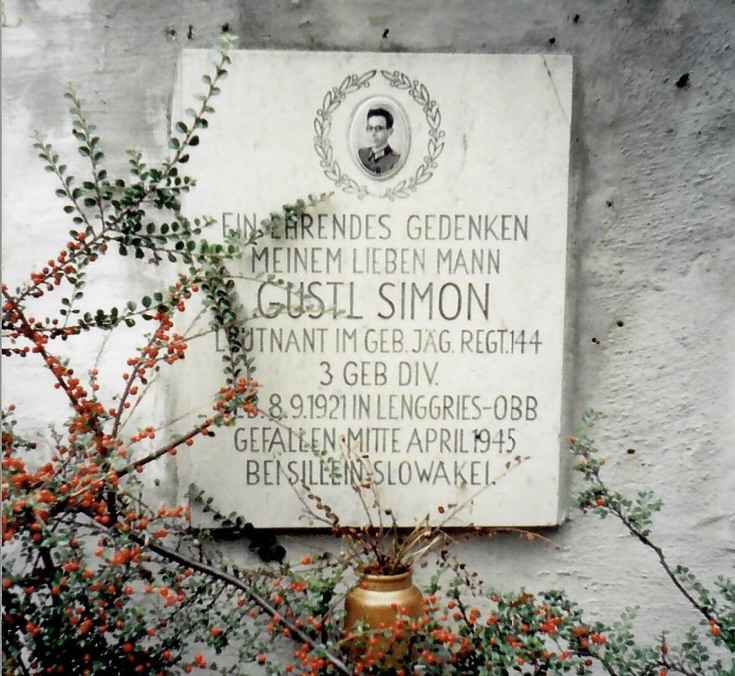
The news took me back more than a quarter of a century to an ancient Bavarian cemetery, where I was astonished to find my own name on a grave. After all, it’s not every day you see your name on a tombstone.
The meeting became part of an eerie, almost mythical rapprochement, as if some invisible thread drew me to that distant place.
And the journey began. where else? – in the incredible world of tennis rackets.
My relationship with racquet companies began shortly before Inside Tennis started. In 1980, as a writer for a short-lived sports business magazine, I covered the Super Bowl and participated in a tennis media tournament sponsored by Head rackets.
Desperate and desperate to win the first prize of a racquet, I went all out, took the title and packed my Head Legend racquet, which has long been my trusted weapon on court.
Years later, when I walked into the San Diego headquarters of the Pro Canucks racquet company, there was a huge sign in the lobby that said, “Welcome Bill Simons – Publisher, Inside Tennis.”
Wow – such a tonic for my ego. “Hey, buddy,” I said to myself, “it’s not that shabby.”
Even better, as my tennis magazine began to thrive and I became an industry player, I received a series of invitations to racket company headquarters.
Visits to Prince in New Jersey and Wilson in Chicago were pleasant outings. It was a pleasure to visit Babolat’s office in an old, garden-like villa in Lyon. But traveling to a village hidden deep in a dense Japanese forest to see the factory where Anna Kournikova’s poster series produced Yonex racquets was unforgettable.
But nothing matched my trip to Germany in October 1999. When Boris Becker became the owner of the Völkl racket company, I was invited to their headquarters.
I agreed to go, but only if I got an interview with Becker.
Völkl met me at the Munich airport and took me to a noisy Oktoberfest biergarten, where I got plastered and, to the delight of the hosts, ended up on top of a table dancing happily as accordions blasted.
Fortunately, I managed to sober up enough until the following evening when I found myself in Becker’s black SUV as he drove me on the Autobahn to his country club south of Munich. There, as we enjoyed our gourmet bratwurst, I asked him why he rejected English writers’ efforts to call him “Boom Boom” Becker.
He bristled, reflected on the brutality of World War II bombings and said he had always been a bit of a contrarian. He explained that he got his fighting streak from his mother, who was interned in a Nazi concentration camp in Czechoslovakia.
“He was Jewish,” Boris confided.
OMG.
I immediately realized that since traditional Jewish law transmits Jewish identity through the mother, Becker, perhaps Germany’s greatest sports hero of the post-Hitler era, would be considered Jewish.
After my wonderful time with the big star, I extended a few days and went to the Munich Tourist Office and asked:
They mentioned a city and added: “You’d better run and catch the train.”
So I headed east for a few hours and got off at Berchtesgaden. I had no idea where I was. Once again I headed to the tourist office.
There a man was amazed. “Don’t you know what Berchtesgaden is? This is where Hitler’s mountain retreat was, the Eagle’s Nest.”
“You’ve got to be kidding me,” I said to myself, and then asked the man what I should do.
“Well,” he said, “my wife has a great excursion to the Eagle’s Nest at 2 p.m. Do it, but first go to the old town and see the ancient cemetery from the 17th century; it’s unbelievable.”
So off I went and soon found myself strolling through centuries-old graves.
Finally, I came to the World War II section and there I spotted it, the grave of a mountain infantryman named Gustle Simon, a German Air Force lieutenant in the Luftwaffe who died in mid-April 1945.
Oh my God – Gustl. It’s Bavarian diminutive for Gustav, and it’s my last name. My great-grandfather was Gustav, my father was Gustav, and my middle name was Gustav.
And my family’s last name was Simon until my father changed it to Simons decades ago. So the person buried here actually had the same name as mine, and he died right around the time I was born, in 1945. on April 12, the day President Franklin Roosevelt died.
So what brought me to this amazing moment? And who was this young, unknown man who, in the chaotic twilight of war, died in the Alps just as I drew my first breath in an American suburb?
I stood there as the swift wind blew through the cemetery and imagined the last, crushing spring of the war; President Roosevelt dies in Georgia and Gustle Simon loses his life in the Alps. Yet in that same narrow window of time, the name Gustave Simon was carried across the Atlantic by an infant in America.
To me it was a quiet commentary on time and legacy, bold in its suggestion but somehow beyond my grasp.
But now I had to rush to the Eagle’s Nest for the van tour.
Over the years I have often traveled to historical sites of infamy or military history. On my trip to that Yonex factory, I also went to Hiroshima. One year while covering the French Open, I left Paris to go to the Normandy coast and walk the sands of Omaha Beach at dawn on D-Day. In New York, I made a pilgrimage to Ground Zero, where grief still hung.
But it was something else as I climbed that infamous German mountain, past Alpine meadows and immaculate clay tennis courts, to an evil place I’d often seen on TV.
Being an anti-war fanatic and lapsed meditator, I decided that when I got to the Eagle’s Nest, I would go alone, meditate, and send an atmosphere of peace into space.
How great!
But the woman running the tour turned out to be a compelling storyteller. She explained that she was the wife of the man I had met at the tourist center and (follow me here) her aunt was a beautiful young woman of Indian royal heritage who was the first female radio operator sent by Britain behind enemy lines in World War II to aid the French resistance. But he was captured, tortured and eventually executed by the Nazis.
“Wait,” I interrupted. I then breathlessly explained that back in California, in Marin County near San Francisco, I had studied for years with a spiritual teacher, Pir Vilayat Khan, who taught a very Western, New Age version of Sufism. And Pir Vilayat’s sister, like her husband’s aunt, was believed to be the first female radio operator sent by British intelligence behind enemy lines.
In fact, they were the same heroine, Noor Inayat Khan, codenamed Madeleine. In Paris, the daring detective was caught, tortured for months, then taken to Dachau, where he was shot in the head.
Just before his death, he uttered one word: “Freedom.”
In just a few hours, I came upon the grave of a German infantryman who bore basically my name and died when I was born, and discovered that my guide was related to the martyred sister of my Sufi teacher and a woman who had long inspired me.
To this day, I honor Noor with a stunning photo in my home. And now that the Eagle’s nest is burned, I return again to that Bavarian hillside;
I still can’t explain what brought all this together. All I know is that the universe we walk through is thick with invisible threads and mysteries that confound and inspire.