


















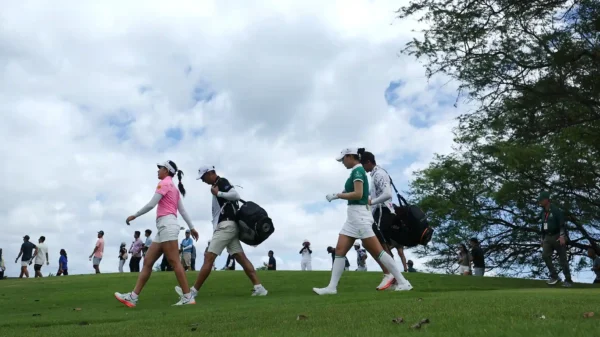























A slow-play penalty turned an otherwise routine hole into a costly one Carlotta Ciganda during the third round of the Buick LPGA Shanghai.
On Saturday, Sky Sports golf commentator Richard Kaufman said Ciganda was assessed a two-stroke penalty after finishing the par-4 13th hole at Sheshan Golf Club. The penalty turned his par into a devastating double bogey, knocking him down the leaderboard.
Two players were penalized for slow play @LPGA today in China. Carlota Ciganda was given a 2 stroke penalty when in contention and responded with 2 immediate birdies. Yealimi Noh also scored a penalty. It’s not the first time for any player.
— Richard Kaufman 🎙⛳️⚽️ (@KaufmanRichard) October 17, 2026
But he didn’t let the penalty derail his round. Ciganda responded with back-to-back birdies on the next two holes and finished with a 1-under 71; she now sits at T4 in Sunday’s final round.
Ciganda wasn’t the only player caught up in the crackdown, either. Yealimi Noh was also penalized for slow play on Saturday.
How the LPGA’s rate of play policy works
So, how does a player lose two shots due to slow play? It takes more than you might think.
Under Updated LPGA rate of play policyofficials usually start by warning a group that falls out of position. This gives players a chance to hit the next hole. If the group fails to make sufficient improvement, the officials can start timing the players.
The policy – updated in 2025 – includes some exceptions. For example, officials can skip the warning if a group is significantly out of position, and can time groups without warning during the last three holes. Officials may also time an individual player at any point during a round if they believe the player’s pace is contributing to the group falling behind.
Once a player is on the clock, they have a set amount of time to hit their shot — usually about 40 seconds — with additional time allowed in certain circumstances. The policy also allows players to bank time, giving them flexibility in how they use their allotted seconds throughout the round.
How many shots can a player lose?
According to the LPGA’s penalty structure, a first timing violation usually results in a warning, while a subsequent violation can result in a one-stroke penalty. Further violations may result in additional penalty strokes, including a two-stroke penalty for a subsequent violation.
The exact sequence of events leading to Ciganda’s penalty has not been confirmed. However, this is not the first time she has received a warning or a slow-play penalty (you may remember her strange disqualification at the Evian Championship 2023).
While the enforcement may strike some as harsh, it is likely a welcome change for many of the LPGA players who have become frustrated with the tour’s pace of play problem. For those who asked for action, these penalties send a clear message that the tour is serious about keeping the wheel moving.